Pragyesh IAS • Daily Current Affairs BPSC Daily Current Affairs...
Read MoreBPSC Polity PYQ Trend Analysis
Topic-Wise Weightage, Repeated Patterns, and High-Yield Strategy
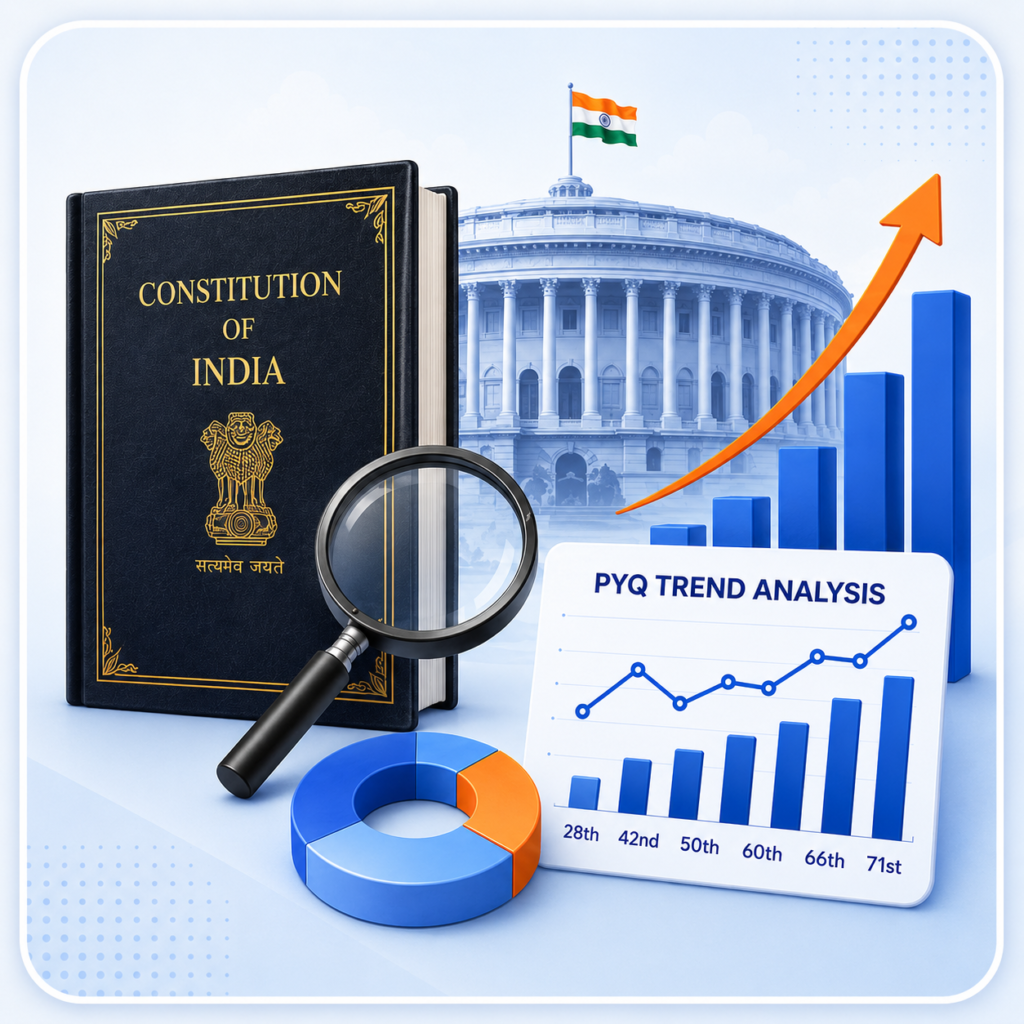
A data-backed analysis of BPSC Polity previous year questions from 38th to 71st BPSC to identify the most important topics, repeated patterns, and practical preparation priorities.
Introduction
Polity is one of the most scoring areas in the BPSC Preliminary Examination, but many aspirants prepare it in a linear textbook manner. They read every chapter with equal weight: Constitution-making, Preamble, Fundamental Rights, Parliament, President, Judiciary, Local Self-Government, Constitutional Bodies, Emergency, and Amendments. However, previous year questions show a very different picture.
BPSC does not ask Polity randomly. It repeatedly returns to a few high-yield areas such as Local Self-Government, Lok Sabha, President, Fundamental Rights, Supreme Court, Schedules, Preamble, DPSP, and Constitutional Bodies.
Important Note
The weightage below should be treated as PYQ-bank weightage, not the official number of polity questions asked in each individual BPSC paper.
This article is based on the uploaded Polity PYQ covering questions from 38th to 71st BPSC, along with some related BPSC-family exams such as CDPO, Assistant, and TRE included in the same compilation. The source contains questions on Constitution-making, sources of the Constitution, schedules, Preamble, parliamentary procedure, Fundamental Rights, local self-government, judiciary, constitutional bodies, and miscellaneous polity.
Methodology
For this analysis, the polity questions were mapped topic-wise and then grouped into broader preparation segments. The mapping produced approximately:
Total mapped polity questions
0
Broad topics
0
Highest-weight topic
Local Self-Government
Most repeated institutional area
Parliament and Local Bodies
Most repeated static area
Schedules, Preamble, Fundamental Rights
Constitution-making questions such as the first meeting of the Constituent Assembly, election of Dr. Rajendra Prasad as Chairman, time taken to frame the Constitution, and the date of adoption and enforcement.
Top 10 BPSC Polity Topics by PYQ Count
Overall Topic-Wise Weightage
The biggest finding is that BPSC Polity questions are concentrated in a few recurring clusters. The top 10 topics account for roughly 60% of all mapped polity questions.
The implication is clear: BPSC Polity should not be prepared only in textbook order. It should be prepared according to PYQ density.
Aspirants should first master:
- Local Self-Government
- Lok Sabha and Rajya Sabha
- President
- Fundamental Rights
- Supreme Court
- Schedules
- Preamble and Basic Structure
- DPSP and Fundamental Duties
Macro-Segment Analysis
Instead of studying only individual chapters, it is better to group Polity into broader exam-useful segments.
| Segment | Major Included Topics | Questions | Approx. Weight |
|---|---|---|---|
| Constitution Basics | Constituent Assembly, sources, parts, schedules, Preamble, nature, citizenship | 69 | 18.30% |
| Parliament & Legislature | Lok Sabha, Rajya Sabha, committees, parliamentary acts, state legislature | 67 | 17.77% |
| Union Executive | President, Vice-President, Council of Ministers, AG/CAG | 45 | 11.94% |
| Local Self-Government | Panchayati Raj and Municipalities | 45 | 11.94% |
| Rights, DPSP & Duties | Fundamental Rights, DPSP, Fundamental Duties | 37 | 9.81% |
| Miscellaneous Polity | Mixed static-current polity | 37 | 9.81% |
| Constitutional / Statutory Bodies | Election Commission, Finance Commission, NITI/Planning, political parties | 29 | 7.69% |
| Judiciary | Supreme Court, High Court, subordinate courts | 23 | 6.10% |
| Federalism, Emergency & Amendments | Centre-state relations, emergency, amendments | 17 | 4.51% |
| Official Language | Rajbhasha / official language | 2 | 0.53% |
The combined weight of Constitution Basics + Parliament + Union Executive + Local Self-Government is almost 60%. This shows that BPSC Polity is heavily focused on institutional and procedural polity.
BPSC repeatedly asks:
- Who appoints whom?
- Who removes whom?
- Which Article applies?
- Which Schedule covers which subject?
- Which body conducts elections?
- Which institution has which power?
- Where can a Money Bill be introduced?
- What is the role of local bodies?
Constitution-Making and Constituent Assembly
The Constitution-making section is not the largest topic, but it is a stable and predictable area. BPSC frequently asks dates, committees, chairpersons, and adoption/enforcement details.
Key Areas to Prepare
Subtopic | BPSC Focus |
First meeting of Constituent Assembly | 9 December 1946 |
Temporary Chairman | Dr. Sachchidananda Sinha |
Permanent Chairman | Dr. Rajendra Prasad |
Drafting Committee | Dr. B. R. Ambedkar |
Adoption date | 26 November 1949 |
Enforcement date | 26 January 1950 |
Time taken to frame Constitution | 2 years, 11 months, 18 days |
📚 Indian Polity MCQ Practice
Select the correct answer and move to next question
0 /
5
Correct
Constitution-Making Timeline
9 Dec 1946
First meeting of Constituent Assembly
11 Dec 1946
Dr. Rajendra Prasad elected permanent Chairman
26 Nov 1949
Constitution adopted
26 Jan 1950
Constitution came fully into force
Sources of the Indian Constitution
BPSC often asks which feature of the Indian Constitution was borrowed from which country. This topic is compact and highly scoring.
Key Source Areas
Country | Borrowed Features |
Britain | Parliamentary system, rule of law, legislative procedure |
USA | Fundamental Rights, judicial review, impeachment of President |
Ireland | DPSP, method of Presidential election, Rajya Sabha nomination |
Canada | Strong Centre, residuary powers, appointment of Governor |
Australia | Concurrent List, joint sitting |
Soviet Union / Russia | Fundamental Duties, social-economic justice |
France | Republic, liberty, equality, fraternity |
South Africa | Constitutional amendment procedure |
Japan | Procedure established by law |
📚 Indian Polity MCQ Practice
Select the correct answer and move to next question
0 /
0
Correct
Schedules of the Constitution
Schedules are among the most scoring areas in BPSC Polity. They are frequently asked through matching, incorrect-pair, and subject-list questions.
The questions include the Third Schedule, Fourth Schedule, Fifth Schedule, Sixth Schedule, Seventh Schedule, Tenth Schedule, and Eleventh Schedule. It also includes recent schedule-based questions asking which subjects fall under the Concurrent List.
Must-Revise Schedules
| Schedule | Subject |
| 3rd Schedule | Oaths and affirmations |
| 4th Schedule | Allocation of Rajya Sabha seats |
| 5th Schedule | Scheduled Areas and Scheduled Tribes |
| 6th Schedule | Tribal areas in Assam, Meghalaya, Tripura, Mizoram |
| 7th Schedule | Union, State, Concurrent Lists |
| 10th Schedule | Anti-defection law |
| 11th Schedule | Panchayats |
| 12th Schedule | Municipalities |
Color Note:
Dark Green = Very High Importance: 7th, 10th, 11th Schedule
Light Green = High Importance: 3rd, 5th, 12th Schedule
Yellow = Medium Importance: 4th Schedule
Dark Green = Very High Importance: 7th, 10th, 11th Schedule
Light Green = High Importance: 3rd, 5th, 12th Schedule
Yellow = Medium Importance: 4th Schedule
📚 Complete MCQs: Schedules
Select the correct answer and move to next question
0 /
0
Correct
Preamble and Basic Structure
The Preamble is a compact but high-return topic. BPSC repeatedly asks about the correct order of words in the Preamble, the 42nd Amendment, “We, the People”, the Preamble as the soul of the Constitution, and the Basic Structure doctrine.
Key Areas
Subtopic | BPSC Focus |
Word order | Sovereign, Socialist, Secular, Democratic, Republic |
42nd Amendment | Socialist, Secular, Integrity |
“We, the People” | Popular sovereignty |
Soul of Constitution | Preamble |
Basic Structure | Kesavananda Bharati case |
Objective Resolution | Source of Preamble |
📚 Complete MCQs: Preamble and Basic Structure
Select the correct answer and move to next question
0 /
0
Correct
Fundamental Rights
Fundamental Rights are a stable high-yield area. BPSC asks Article-based, writ-based, and remedy-based questions.
The questions on equality, Article 17, Article 19, Article 21A, Article 32, Article 226, and protection of Fundamental Rights by the Supreme Court and High Courts.
Important Articles
Article | Subject |
Article 12 | Definition of State |
Article 13 | Laws inconsistent with Fundamental Rights |
Article 14 | Equality before law |
Article 17 | Abolition of untouchability |
Article 19 | Freedoms |
Article 21 | Life and personal liberty |
Article 21A | Right to Education |
Article 32 | Constitutional remedies |
Article 226 | High Court writ jurisdiction |
Article 300A | Property right |
📚 Complete MCQs: Fundamental Rights
Select the correct answer and move to next question
0 /
0
Correct
System of Government
BPSC asks conceptual questions on the nature of the Indian Constitution, parliamentary system, democracy, rule of law, and supremacy of the Constitution.
📚 Complete MCQs: System of Government
Select the correct answer and move to next question
0 /
0
Correct
President of India
The President is the most important topic in the Union Executive segment. BPSC repeatedly asks about executive power, election, impeachment, re-election, ordinance power, and nomination.
Important Articles
Article | Subject |
Article 52 | There shall be a President of India |
Article 53 | Executive power of the Union |
Article 54 | Electoral college |
Article 55 | Manner of election |
Article 57 | Re-election |
Article 61 | Impeachment |
Article 71 | Election disputes |
Article 72 | Pardoning power |
Article 123 | Ordinance power |
📚 Complete MCQs: President
Select the correct answer and move to next question
0 /
0
Correct
President vs Governor Comparison Table
Feature | President | Governor |
Constitutional Article | Article 52 | Article 153 |
Level | Union | State |
Selection | Election | Appointment |
Ordinance Power | Article 123 | Article 213 |
Removal | Impeachment | Pleasure of President |
Lok Sabha
Lok Sabha is the most important parliamentary topic in the BPSC Polity PYQ bank. The PDF contains questions on the Leader of Lok Sabha, Speaker, Money Bill, Article 110, Lok Sabha Secretariat, and voting powers of the Speaker.
📚 Complete MCQs: Lok Sabha
Select the correct answer and move to next question
0 /
0
Correct
Rajya Sabha
Rajya Sabha questions are fewer than Lok Sabha questions, but they are highly repetitive and predictable.
📚 Complete MCQs: Rajya Sabha
Select the correct answer and move to next question
0 /
0
Correct
Supreme Court and Judiciary
Supreme Court questions have become more important in recent papers. BPSC asks about jurisdiction, Fundamental Rights, judicial review, Basic Structure, advisory jurisdiction, and original jurisdiction.
📚 Complete MCQs: Supreme Court
Select the correct answer and move to next question
0 /
0
Correct
Local Self-Government
Local Self-Government is the most important standalone topic in the BPSC Polity PYQ bank. It includes Panchayati Raj, municipalities, 73rd and 74th Amendments, State Election Commission, State Finance Commission, Eleventh Schedule, Twelfth Schedule, and committees such as Balwant Rai Mehta and Ashok Mehta.
Key Areas
Area | Must Remember |
Article 40 | Village Panchayats |
73rd Amendment | Panchayati Raj |
74th Amendment | Municipalities |
11th Schedule | 29 Panchayat subjects |
12th Schedule | Municipal subjects |
State Election Commission | Local body elections |
State Finance Commission | Local body finance |
Balwant Rai Mehta | Three-tier Panchayati Raj |
Ashok Mehta | Two-tier Panchayati Raj model |
📚 Complete MCQs: Local Self-Government
Select the correct answer and move to next question
0 /
0
Correct
DPSP and Fundamental Duties
DPSP questions are often Article-matching based. Fundamental Duties are fewer but direct and scoring.
Important DPSP Articles
Article | Subject |
Article 40 | Village Panchayats |
Article 44 | Uniform Civil Code |
Article 48 | Agriculture and animal husbandry |
Article 48A | Environment |
Article 50 | Separation of judiciary and executive |
Article 51 | International peace |
📚 Complete MCQs: DPSP and Duties
Select the correct answer and move to next question
0 /
0
Correct
Election Commission and Constitutional Bodies
BPSC asks direct questions from constitutional and statutory bodies. Election Commission, Finance Commission, Planning Commission/NITI Aayog, and political parties appear repeatedly.
📚 Complete MCQs: Constitutional Bodies
Select the correct answer and move to next question
0 /
0
Correct
Question-Type Trend: How BPSC Polity Has Changed
Earlier Pattern
Older BPSC Polity questions were mostly direct:
- When was the first meeting of the Constituent Assembly held?
- When was the Constitution adopted?
- Who elects the Speaker?
- Which Article deals with village panchayats?
- Which Schedule deals with anti-defection?
Recent Pattern
Recent questions are more layered and tricky:
- Statement-based questions
- Matching-list questions
- Incorrectly matched pair questions
- “More than one / none of the above” options
- Schedule and Article-based precision
- Current-static combination
A good example is schedule-based testing, where BPSC asks whether specific subjects belong to the Union List, State List, or Concurrent List. The uploaded PDF includes recent questions of this type, especially from the schedules section.
High-Yield Micro-Themes to Revise
Rank | Micro-Theme | Why It Matters |
1 | 73rd and 74th Amendments | Highest local governance weight |
2 | Article 40 | Panchayati Raj and DPSP link |
3 | 11th and 12th Schedules | Panchayat and municipality subjects |
4 | Lok Sabha Speaker | Repeated procedural topic |
5 | Money Bill / Article 110 | Frequently asked parliamentary area |
6 | President’s election | Electoral college and procedure |
7 | Article 53 | Executive power of Union |
8 | Article 14 / 19 / 21 / 21A / 32 | Core Fundamental Rights |
9 | Writs | Direct scoring area |
10 | Supreme Court jurisdiction | Recent favorite |
11 | Judicial Review | Conceptual recurring theme |
12 | Schedules 3, 4, 5, 6, 7, 10, 11, 12 | Matching and list-based questions |
13 | Preamble word order | Easy repeated area |
14 | 42nd Amendment | Preamble and Fundamental Duties |
15 | Kesavananda Bharati | Basic Structure doctrine |
16 | Election Commission | Article 324 and party recognition |
17 | Finance Commission | Article 280 |
18 | DPSP article matching | Articles 40, 44, 48, 50, 51 |
19 | Rajya Sabha tenure | Permanent House and six-year term |
20 | Property right | Article 300A and 44th Amendment |
Recommended Preparation Strategy
Priority 1: Must Master First
Topic | Reason |
Local Self-Government | Highest single-topic weight |
Lok Sabha | Very frequent and procedural |
President | Core Union Executive |
Fundamental Rights | Article + writ-based questions |
Supreme Court | Rising recent trend |
Schedules | Compact and scoring |
Rajya Sabha | Repetitive factual pattern |
Preamble + Basic Structure | Easy and repeatedly asked |
These topics together cover nearly half of the mapped polity question bank.
Priority 2: Strong Support Topics
Topic | Focus |
DPSP | Article matching |
Fundamental Duties | 42nd and 86th Amendments |
Council of Ministers | Collective responsibility |
Vice-President | Rajya Sabha connection |
Governor | Comparison with President |
State Legislature | State-service relevance |
Election Commission | Article 324 |
Finance Commission | Article 280 |
Constitutional Amendments | 42nd, 44th, 52nd, 73rd, 74th, 86th, 104th |
Priority 3: Quick Revision Topics
Topic | Strategy |
Citizenship | CAA and citizenship acquisition methods |
Official Language | Short factual revision |
Order of Precedence | Memorise list |
Parliamentary Committees | Revise key committees only |
Centre-State Relations | Basic Articles and disputes |
Emergency | Articles 352, 356, 360 |
Political Parties | Election Commission powers |
30-Day Polity Revision Plan for BPSC
| Days | Target |
| Day 1–5 | Local Self-Government |
| Day 6–9 | Lok Sabha + Rajya Sabha |
| Day 10–12 | President + Vice-President |
| Day 13–16 | Fundamental Rights + Writs |
| Day 17–19 | Supreme Court + High Court |
| Day 20–21 | Schedules |
| Day 22–23 | Preamble + Basic Structure + Sources |
| Day 24–25 | DPSP + Fundamental Duties |
| Day 26–27 | Constitutional Bodies |
| Day 28 | Amendments + Emergency |
| Day 29 | State Government |
| Day 30 | Full PYQ revision |
Conclusion
The BPSC Polity PYQ trend shows a clear and repeated pattern. The exam is not evenly distributed across the entire Indian Polity syllabus. Instead, it repeatedly asks from a predictable set of clusters:
Local Self-Government → Parliament → President → Fundamental Rights → Supreme Court → Schedules → Preamble → DPSP → Constitutional Bodies
The single most important topic is Local Self-Government, followed by Lok Sabha, President, Fundamental Rights, Supreme Court, and Schedules.
Recent BPSC questions are becoming more statement-based and schedule/article-oriented. Therefore, aspirants must go beyond simple memorisation. The best strategy is to prepare through:
- Article tables
- Schedule maps
- Comparison charts
- PYQ clusters
- Institution-wise flowcharts
- Amendment timelines
- Repeated MCQ practice
If a candidate masters the high-frequency areas first and then revises lower-frequency topics through short notes, Polity can become one of the most scoring sections in BPSC Prelims.