Union Budget 2026-27 continues the strategy of supporting growth through high capital expenditure while keeping the fiscal deficit on a consolidation path. This page gives you exam-ready highlights with the most important numbers, sector allocations, and concepts for Prelims and Mains.
At a Glance
Headline Numbers (BE 2026-27)
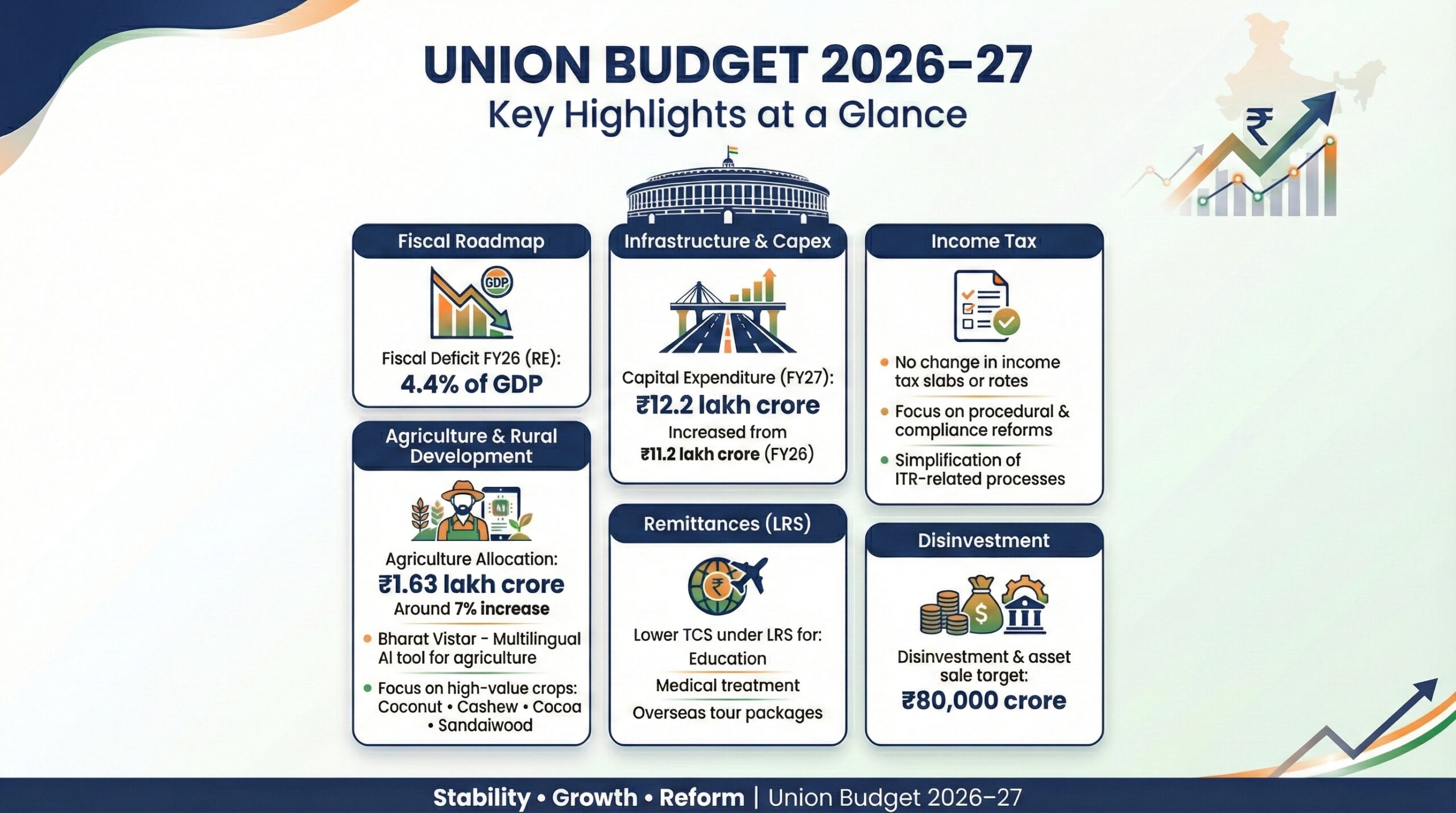
Total Expenditure: ₹53,47,315 crore
Capital Expenditure (Capex): ₹12,21,821 crore
Effective Capex: ₹17,14,523 crore
Fiscal Deficit: ₹16,95,768 crore and 4.3% of GDP
Revenue Deficit: ₹5,92,344 crore and 1.5% of GDP
Primary Deficit: ₹2,91,796 crore and 0.7% of GDP
Sector Must-Track (High Exam Probability)
Agriculture (reported in coverage): ₹1.63 lakh crore
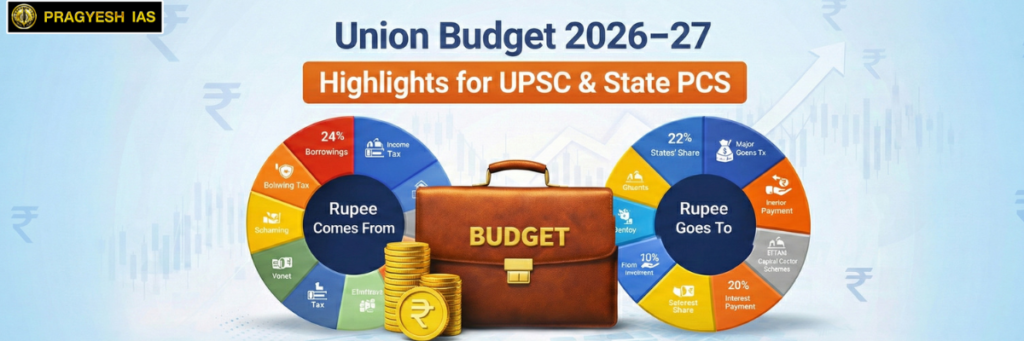
“How does the Government finance every rupee?” The chart is expressed as paise per rupee for Budget 2026-27.
Rupee Comes From (Budget 2026-27)
Borrowings & Other Liabilities: 24 paise
Income Tax (includes Securities Transaction Tax): 21 paise
Corporation Tax: 18 paise
GST & Other Taxes: 15 paise
Non-Tax Revenue: 10 paise
Union Excise Duties: 6 paise
Customs: 4 paise
Non-debt Capital Receipts: 2 paise
Exam-ready concept
A higher share of Borrowings indicates greater reliance on debt financing, which links to questions on debt sustainability, interest burden, and fiscal space.
Keywords to highlight: Borrowings, Tax buoyancy, Non-tax revenue, Non-debt capital receipts, Fiscal space.
Where the Rupee Goes To
The chart is expressed as paise per rupee for Budget 2026-27.
Fiscal Strategy and Key Ratios
Key terms (write these correctly in Mains)
Fiscal Deficit (FD): Government’s total borrowing requirement in a year. Target: 4.3% of GDP
Revenue Deficit (RD): Borrowing used for routine (non-asset) expenditure; indicates quality of consolidation. Target: 1.5% of GDP
Primary Deficit: Fiscal deficit minus interest payments; shows current-year stance excluding past debt costs. Target: 0.7% of GDP
Effective Capex: Capex plus grants for capital assets. ₹17,14,523 crore
Exam-ready concepts
Capex is considered growth-friendly because it creates assets and raises productivity.
Lower RD is associated with better quality of deficit (less borrowing for day-to-day spending).
Infrastructure and Capex
Key data
Capex (BE 2026-27): ₹12.218 lakh crore
Effective Capex (BE 2026-27): ₹17.145 lakh crore
Why it matters
Links to logistics efficiency, cost of doing business, and multiplier effect.
Use the concept of crowding-in private investment in GS-3 answers.
Keywords to highlight: Capex-led growth, Multiplier, Crowding-in, Logistics, Productive expenditure.
Agriculture and Rural Economy
Key highlight
Bharat Vistar (Bharat VISTAAR): multilingual AI-based agriculture tool/platform for decision support and best practices (as highlighted in budget coverage).
Exam-ready concepts
Link to digital agriculture, extension reforms, climate resilience, and value chains for higher farm incomes.
Keywords to highlight: Agri-tech, Value chains, Extension services, High-value agriculture, Rural livelihoods.
Education and Skills
Key scheme allocations (BE 2026–27)
Samagra Shiksha: ₹42,100 crore
PM POSHAN: ₹12,750 crore
PM SHRI: ₹7,500 crore
PM-USHA: ₹1,850 crore
How to write this in Mains
Education spending builds human capital.
PM POSHAN supports the nutrition-learning link.
PM SHRI and Samagra Shiksha support quality and infrastructure.
Keywords to highlight: Human capital, Learning outcomes, Foundational literacy, Nutrition-learning link.
Defence and Modernisation
Key highlight
Defence remains a major spending head in “Rupee Goes To”: 11 paise per rupee.
Exam-ready concepts
UPSC often asks about capital vs revenue in defence and its impact on modernisation and readiness.
Keywords to highlight: Modernisation, Preparedness, Indigenisation, Capital outlay.
Health and Biopharma
Key highlight
Biopharma Shakti: ₹10,000 crore outlay (reported in coverage) to strengthen biopharma manufacturing ecosystem.
Exam-ready concepts
Link to health security, pharma self-reliance, and innovation ecosystem.
Keywords to highlight: Biopharma ecosystem, Health security, Manufacturing capability, Innovation.
Disinvestment and Other Receipts Target
Key data (BE 2026-27)
Disinvestment Target: ₹80,000 crore
Why it matters
This supports non-debt capital receipts, reducing borrowing pressure if achieved.
Keywords to highlight: Disinvestment, Asset monetisation, Non-debt receipts, Fiscal space.
Federalism: Transfers to States
Key data (BE 2026-27)
Resources transferred to States: ₹25,43,769 crore
Why it matters
Directly linked to cooperative federalism and state capacity to deliver welfare and infrastructure.
Financial Markets: STT Changes
Key data (reported)
STT on Options premium: 0.10% → 0.15%
STT on Futures: 0.02% → 0.05%
Concept
Aims to curb excessive churn; increases cost for frequent derivatives activity.