
The Mughal Empire didn’t rise in a single day—it was built through battles, sieges, campaigns, alliances, and long wars. This blog gives you a clear, chronological timeline of the most important Mughal-era wars and battles, ruler by ruler, with year, opponents, cause, key point, and outcome—perfect for quick revision.
Timeline at a glance
Babur → Humayun → Akbar → Jahangir → Shah Jahan → Aurangzeb
1526 to 1707 (from empire’s foundation to the era of exhaustion)
Babur (1526–1530): Foundation of the Mughal Empire
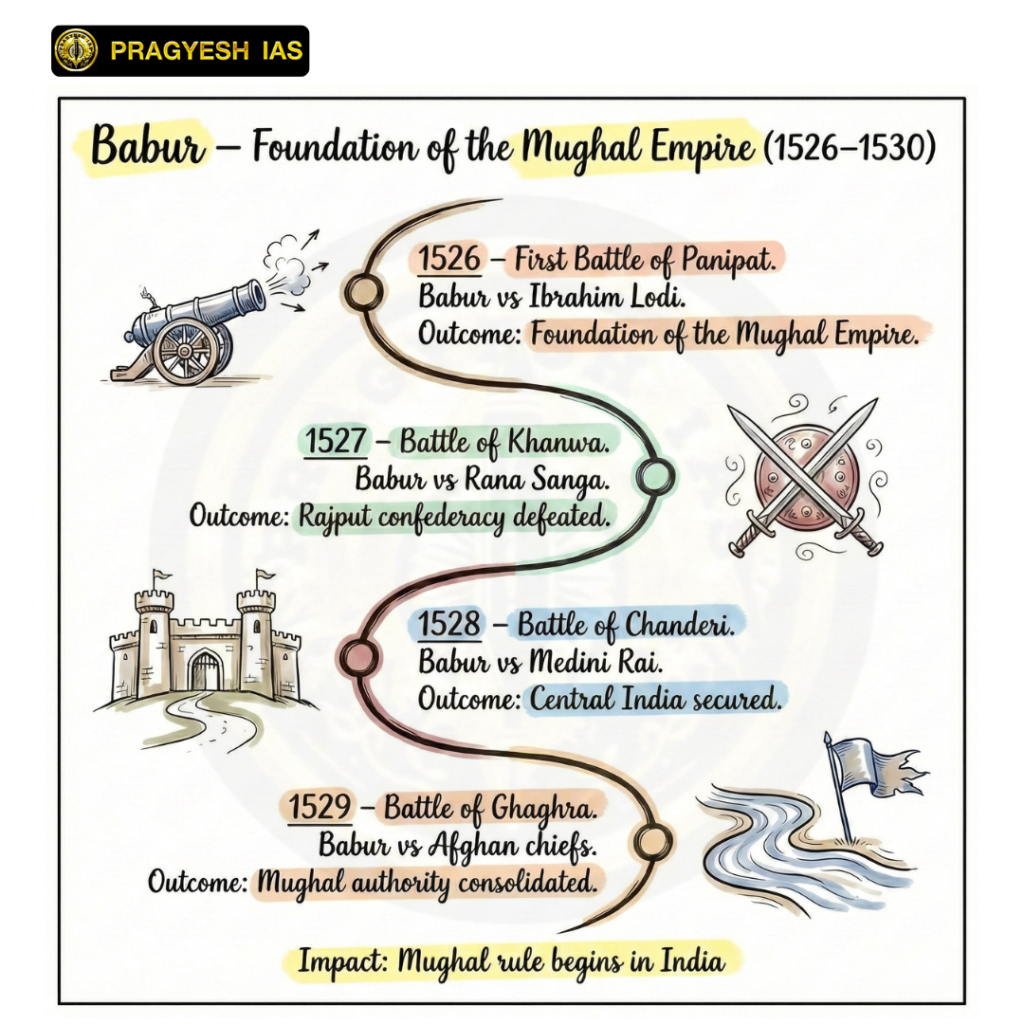
1526 — First Battle of Panipat
Vs: Babur vs Ibrahim Lodi
Cause: Control of Delhi and North India
Key point: Effective battlefield tactics and artillery use
Outcome: Babur wins; Mughal rule begins in India
1527 — Battle of Khanwa
Vs: Babur vs Rana Sanga (Rajput confederacy)
Cause: Rajput challenge to Babur’s new rule
Key point: Decisive contest for North India
Outcome: Babur wins; Rajput coalition weakens
1528 — Battle of Chanderi
Vs: Babur vs Medini Rai
Cause: Securing forts and strategic regions
Key point: Fort-focused warfare
Outcome: Babur wins; central region control strengthens
1529 — Battle of Ghaghra
Vs: Babur vs Afghan chiefs
Cause: Afghan resistance in the east
Key point: Final major consolidation battle
Outcome: Babur wins; authority stabilizes
Babur’s impact: The Mughal Empire is founded and secured against early challengers.
Humayun (1530–1556): Fall, Exile, and Return
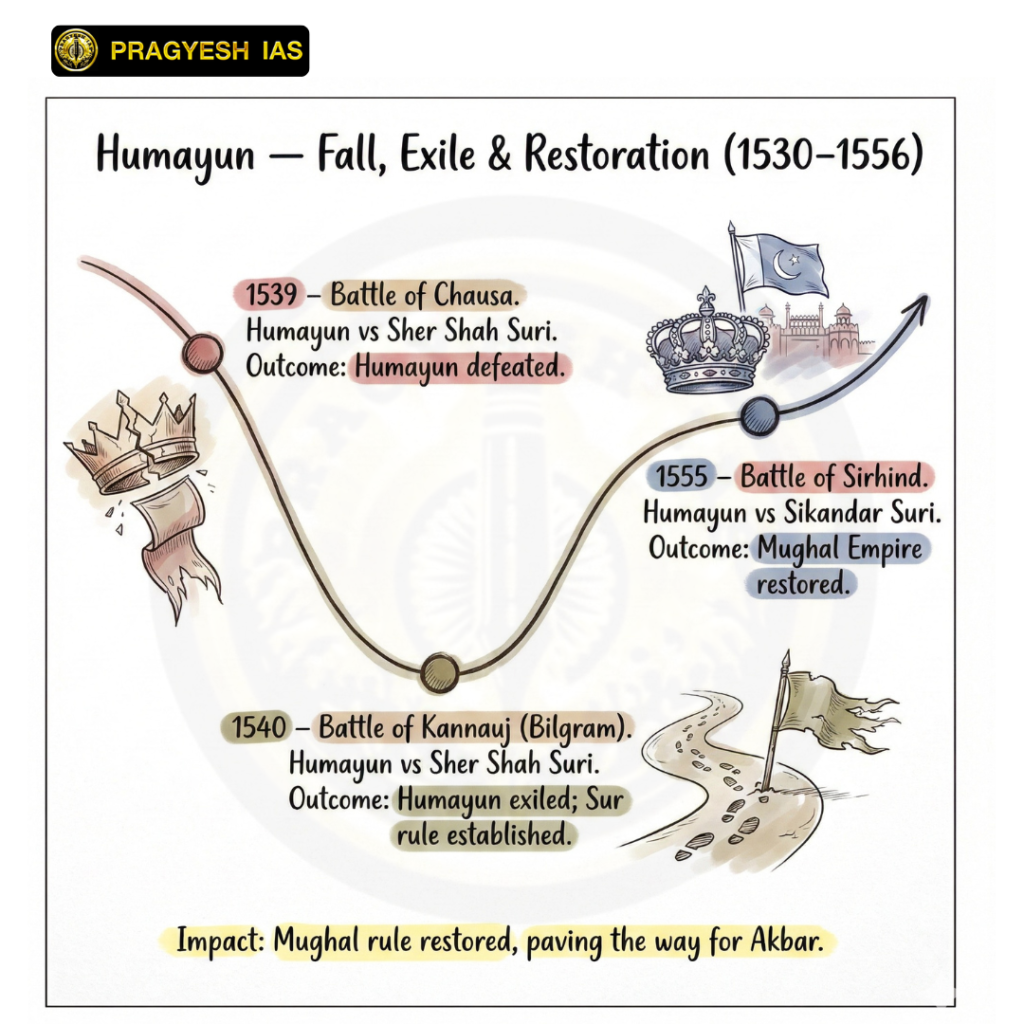
1539 — Battle of Chausa
Vs: Humayun vs Sher Shah Suri
Cause: Afghan power rising against Mughals
Key point: Major defeat for Humayun
Outcome: Humayun loses; Mughal control collapses fast
1540 — Battle of Kannauj (Bilgram)
Vs: Humayun vs Sher Shah Suri
Cause: Final fight for North India
Key point: Decisive Afghan victory
Outcome: Humayun exiled; Sur Empire dominates
1555 — Battle of Sirhind
Vs: Humayun vs Sikandar Suri
Cause: Restoration of Mughal rule
Key point: Successful comeback campaign
Outcome: Humayun wins; Mughals return to power
Humayun’s impact: The empire survives a complete collapse—and returns stronger under Akbar.
Akbar (1556–1605): Expansion and Consolidation
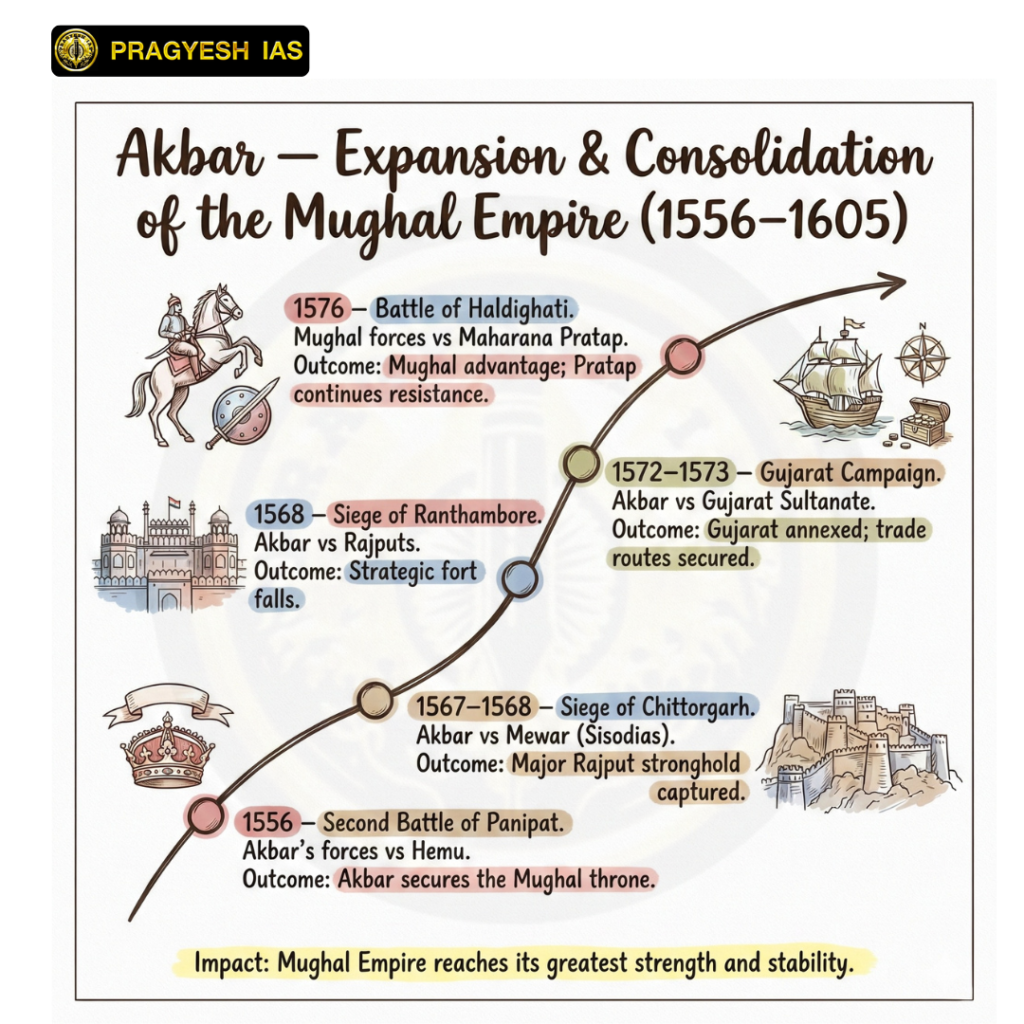
1556 — Second Battle of Panipat
Vs: Akbar’s forces vs Hemu
Cause: Control after Humayun’s death
Key point: Turning-point battle securing the throne
Outcome: Mughal victory; Akbar’s rule stabilizes
1567–1568 — Siege of Chittorgarh
Vs: Akbar vs Mewar (Sisodias)
Cause: Control of a major Rajput stronghold
Key point: Long siege with heavy artillery
Outcome: Mughal victory; major fort captured
1568 — Siege of Ranthambore
Vs: Akbar vs Rajputs
Cause: Control of strategic routes and forts
Key point: Fort falls after siege operations
Outcome: Mughal victory
1572–1573 — Gujarat Campaign
Vs: Akbar vs Gujarat Sultanate
Cause: Trade routes, ports, and revenue
Key point: Rapid campaign and annexation
Outcome: Gujarat annexed; Mughal finances strengthen
1576 — Battle of Haldighati
Vs: Mughal forces vs Maharana Pratap
Cause: Mewar resistance to Mughal control
Key point: Fierce battle; long resistance continues
Outcome: Mughal advantage; Pratap retreats and continues resistance
Akbar’s impact: The empire expands massively and becomes administratively stable.
Jahangir (1605–1627): Stability and Strategic Control
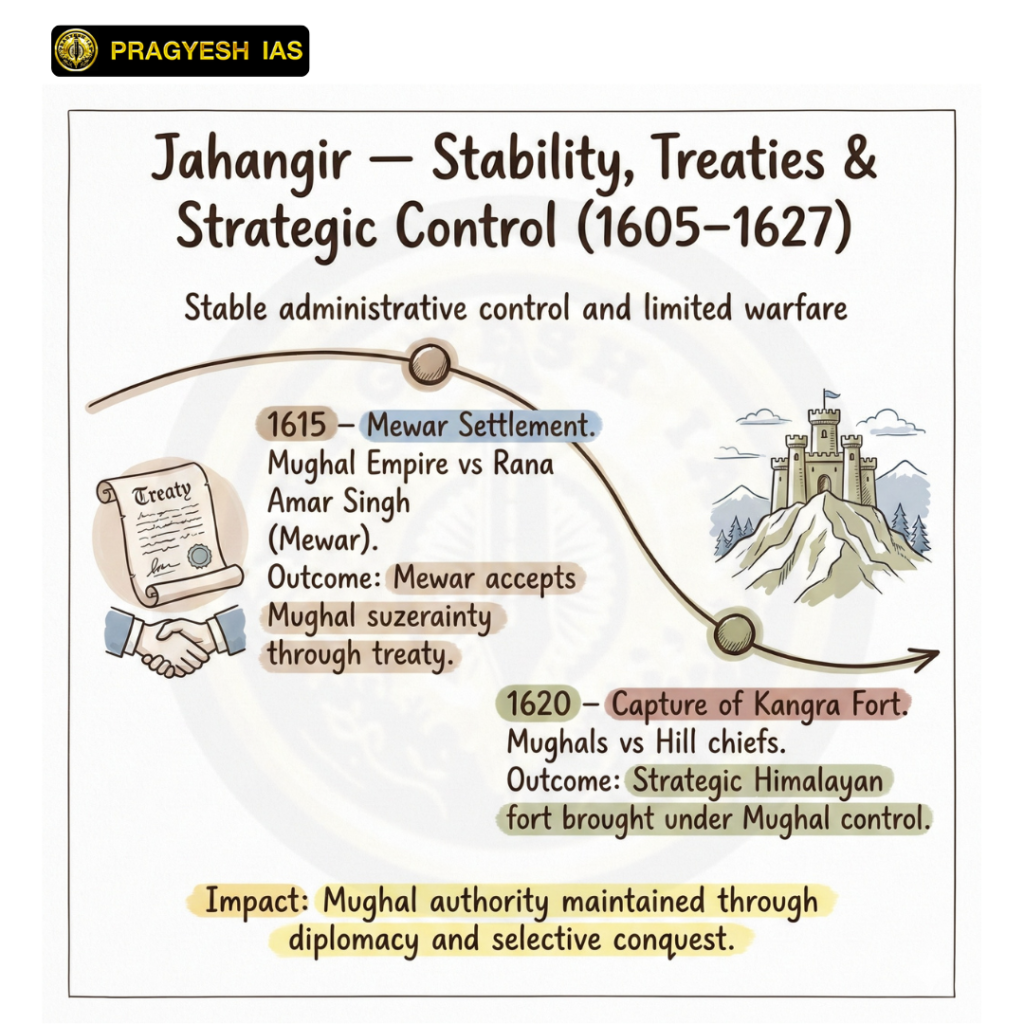
1615 — Mewar Settlement
Vs: Mughal Empire vs Rana Amar Singh (Mewar)
Cause: End prolonged conflict with Mewar
Key point: Treaty-based submission
Outcome: Mewar accepts Mughal suzerainty
1620 — Capture of Kangra Fort
Vs: Mughals vs hill chiefs
Cause: Strategic fort and regional control
Key point: Fort secured under Mughal authority
Outcome: Mughal control strengthened in the region
Jahangir’s impact: Power maintained through diplomacy and targeted conquests.
Shah Jahan (1628–1658): Peak Power and Succession Crisis
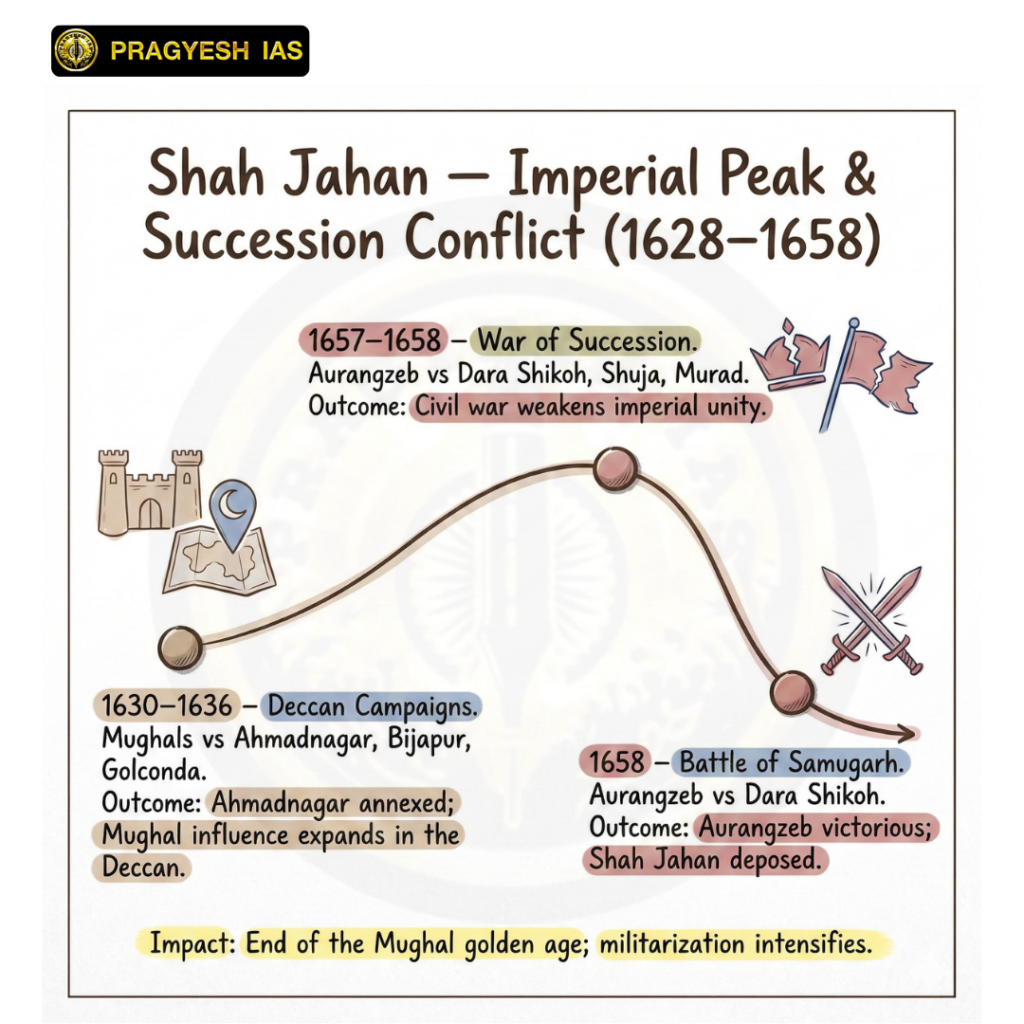
1630–1636 — Deccan Campaigns
Vs: Mughals vs Ahmadnagar, Bijapur, Golconda
Cause: Southern expansion and tribute control
Key point: Deccan pressure increases Mughal reach
Outcome: Ahmadnagar annexed; influence expands
1657–1658 — War of Succession
Vs: Aurangzeb vs Dara Shikoh, Shuja, Murad
Cause: Struggle for the throne
Key point: Civil war inside the empire
Outcome: Imperial unity weakens
1658 — Battle of Samugarh
Vs: Aurangzeb vs Dara Shikoh
Cause: Decisive succession battle
Key point: Turning point of the civil war
Outcome: Aurangzeb wins; Shah Jahan is deposed
Shah Jahan’s impact: The empire reaches a peak, then slips into internal conflict.
Aurangzeb (1658–1707): Expansion, Endless War, and Exhaustion
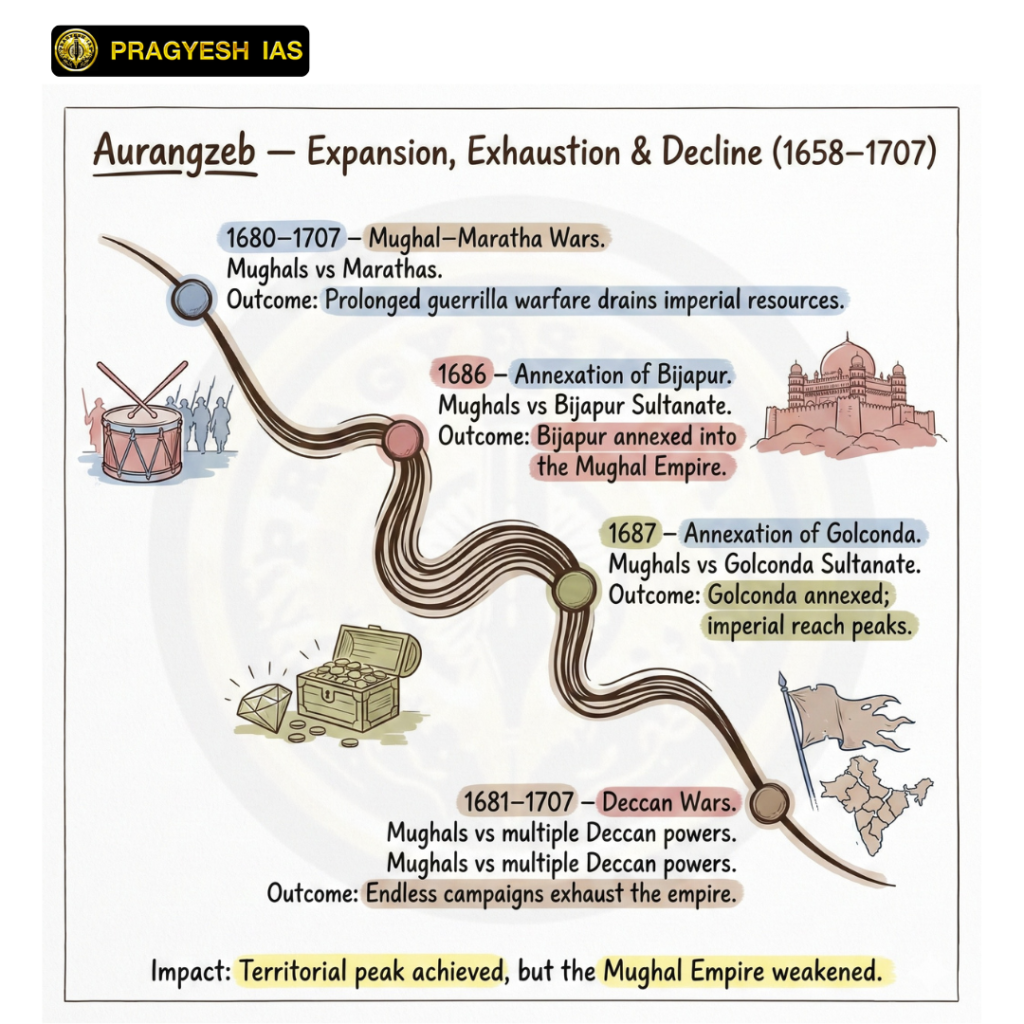
1680–1707 — Mughal–Maratha Wars
Vs: Mughals vs Marathas
Cause: Control of Deccan and resistance
Key point: Guerrilla warfare and constant conflict
Outcome: Resources drained; instability grows
1686 — Annexation of Bijapur
Vs: Mughals vs Bijapur Sultanate
Cause: Eliminate Deccan rival
Key point: Siege and conquest
Outcome: Bijapur annexed
1687 — Annexation of Golconda
Vs: Mughals vs Golconda Sultanate
Cause: Strategic control and wealth
Key point: Fort falls after siege
Outcome: Golconda annexed; territorial peak
1681–1707 — Deccan Wars (continuous campaigning)
Vs: Multiple Deccan powers and resistance forces
Cause: Total control over the south
Key point: Long wars overstretch the empire
Outcome: Exhaustion accelerates Mughal decline
Aurangzeb’s impact: The empire reaches its widest spread—but the cost weakens it deeply.
Conclusion: How wars shaped the Mughal story
From Babur’s Panipat to Aurangzeb’s Deccan wars, Mughal history is a story of power built through warfare. Early victories created a strong empire, Akbar’s conquests consolidated it, and later decades of continuous conflict—especially in the Deccan—drained resources and weakened control, setting the stage for decline after 1707.
Quick revision takeaway
1526: Mughal Empire begins
1555–56: Restoration + Akbar’s consolidation
1572–73: Revenue/trade expansion (Gujarat)
1657–58: Succession crisis
1680–1707: Endless wars → exhaustion