Lord Cornwallis (1786–1793): Reforms, Mysore War, Legacy
Profile & Background
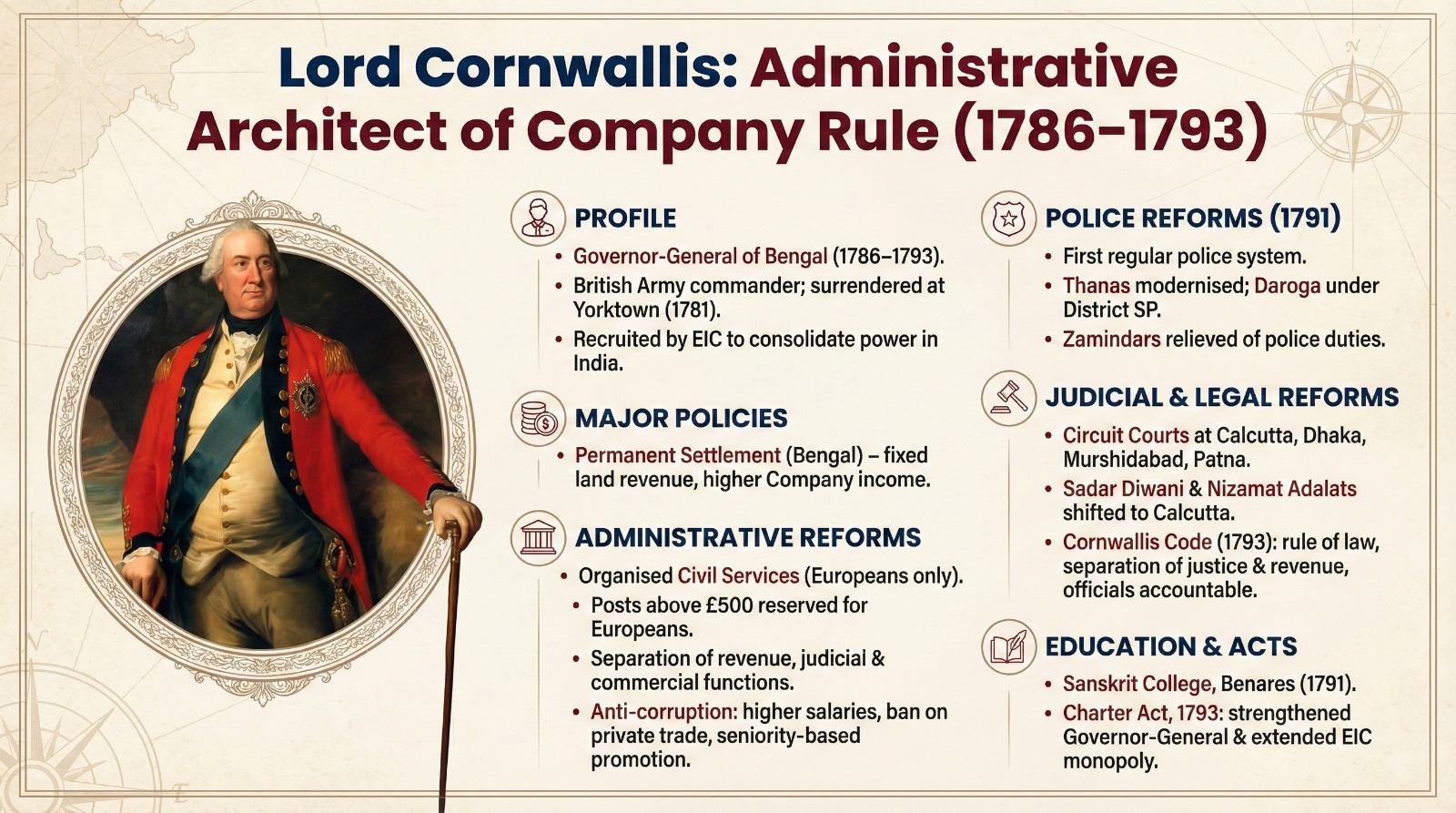
Charles Cornwallis served as Governor-General of Bengal (1786–1793) and was also a senior British Army commander.
The East India Company (EIC) appointed him in India to strengthen and consolidate its political–military control.
Known as a reform-oriented administrator.
He is remembered in North American history for the surrender at Yorktown (1781) to combined American and French forces.
Major Revenue Policy
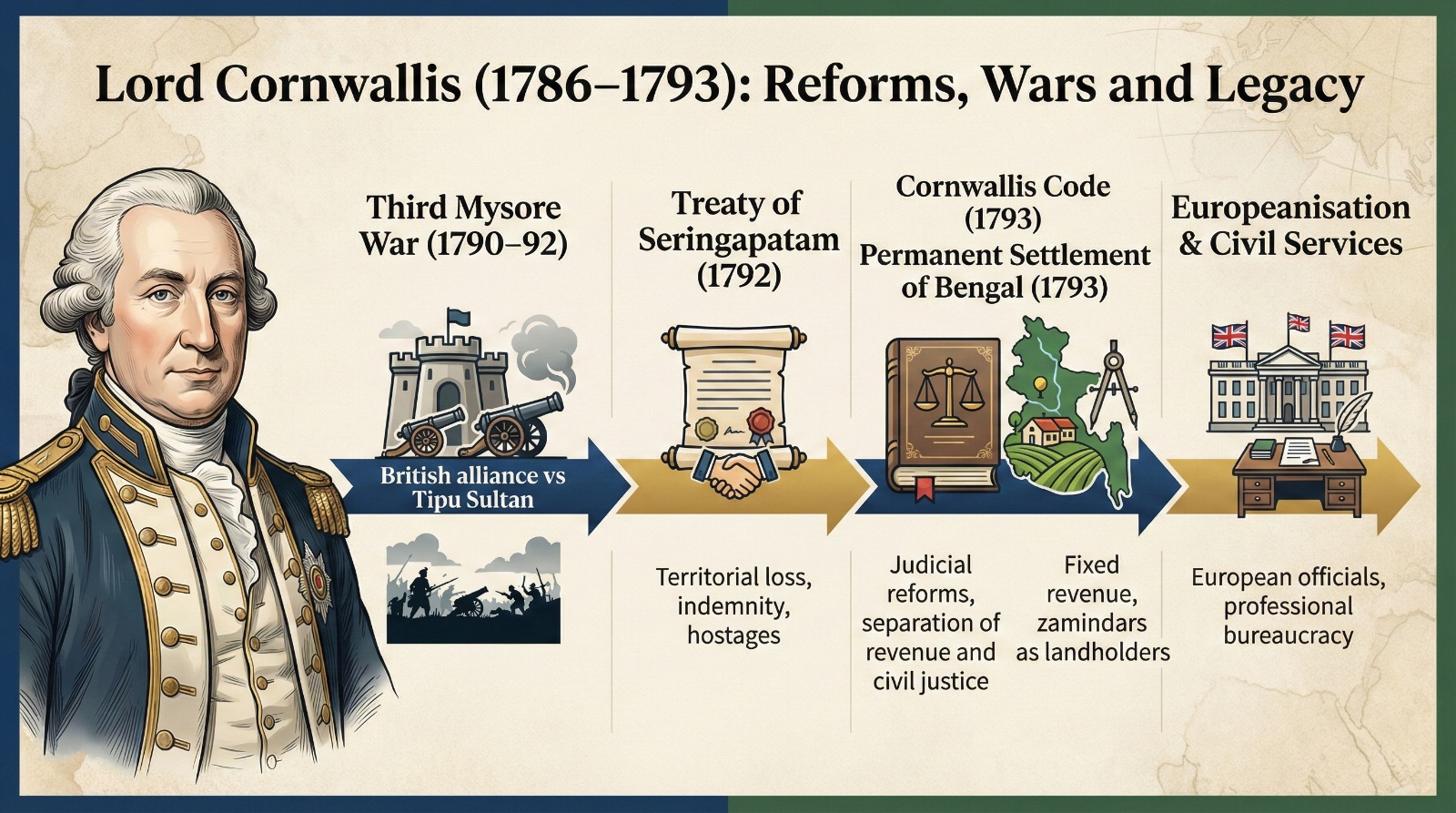
Permanent Settlement-1793 (Bengal)
Introduced the Permanent Settlement, aimed at stabilising land revenue and increasing Company income in Bengal.
Wars & Diplomacy
Third Anglo–Mysore War (1790–1792)
Cornwallis played a leading role in the Company’s victory over Tipu Sultan.
The war ended with the Treaty of Seringapatnam (1792).
Civil Service & Administrative Reforms
Civil Services Organisation
Cornwallis systematised and organised the Company’s civil administration (often linked with the “Cornwallis reforms”).
European Monopoly in Higher Services
Recruitment to higher civil posts was restricted to Europeans, reflecting distrust of Indians in top administration.
Senior Indian officials were removed, and high-value posts were closed to them.
Positions above £500 per year were reserved for Europeans.
Separation of Functions (Checks & Balance)
Introduced clearer separation between commercial, judicial, and revenue roles.
Collectors lost judicial authority and were confined mainly to revenue duties.
Anti-Corruption Measures
Sought to curb corruption by:
Raising salaries of Company servants to reduce the lure of private trade.
Strictly enforcing the ban on private trade.
Taking action against officials accepting bribes, gifts, and “presents.”
Making seniority the main basis for promotions to reduce favouritism.
Police Reforms
Background (Before Cornwallis)
Pre-colonial India did not have a modern police structure; under later Mughals:
Faujdars handled law and order (largely rural/territorial).
Kotwal managed city policing and order.
Amils were revenue officials.
During Dual Government (1765–1772), zamindars maintained thanedars, but dereliction of duties led to rising dacoity.
Regular Police Force (1791)
Cornwallis established a regular police system (1791).
The thana (police circle) system was modernised.
Each thana was placed under a Daroga (Indian).
District-level supervision came under a Superintendent of Police (SP).
Zamindars were relieved of police responsibilities; control shifted towards judicial authorities (district judge).
Law Reforms
Cornwallis Code (1793)
Introduced major legal principles and administrative restructuring:
Separation of revenue and judicial administration
European subjects brought under jurisdiction (greater uniformity)
Government officials made answerable to civil courts for acts done in official capacity
Emphasised the sovereignty of law
Hindu and Muslim laws were separately compiled/codified for use in courts
Sanskrit College (1791)
Jonathan Duncan founded the Sanskrit College at Benares (1791) to promote study of Hindu law and philosophy.
Charter Act of 1793 (Key Provisions)
Renewed the EIC trade monopoly in India for 20 more years.
Provided that the Board of Control members and staff would be paid from Indian revenues.
Extended Cornwallis-style overriding authority: the Governor-General’s overriding power over his Council was extended to future Governor-Generals and Governors of Presidencies.
Strengthened the Governor-General’s control over Bombay and Madras presidencies.
Made the Commander-in-Chief ineligible for Council membership unless specifically appointed (as GG).
Judicial Reforms (Criminal and Civil)
Criminal Justice Changes
District Faujdari courts with Indian judges were abolished.
Four Circuit Courts were set up at Calcutta, Dhaka, Murshidabad, and Patna, staffed by European judges.
Circuit courts acted as appellate courts for civil and criminal matters.
The highest level of this circuit system was centred at Calcutta.
Sadar Nizamat Adalat was shifted to Calcutta.
Civil Justice Changes
The Diwani Adalats introduced earlier were reorganised and renamed as District/City/Zila Courts.
These courts were placed under a District Judge.
The Collector was confined to revenue collection only (no magisterial/judicial role).
Appeals from district courts continued to go to the Sadar Diwani Adalat (also shifted to Calcutta).
Top Judicial Authority
The Governor-General and Council were to preside over:
Sadar Diwani Adalat
Sadar Nizamat Adalat (assisted by Chief Qazi and Chief Mufti)