
India’s CPI has been “Rebased” to 2024
What UPSC/BPSC aspirants absolutely need to know about the new series.
The headline retail inflation for January 2026 is 2.75% (Combined)—with Rural 2.73% and Urban 2.77%—but the bigger story is that this is the first print under the new CPI series with base year 2024=100.
Click here to Views Slides
The Anchor: What does “Base Revision” mean?
In simple terms, a CPI is a cost-of-living index built from two main blocks:
- Weights (What households spend their money on)
- Prices (What those things cost today)
The 2024 Shift:
In the new CPI (Base 2024), weights are derived from the HCES 2023–24 survey, and base-period prices were collected throughout Jan–Dec 2024.
Takeaway: This creates a tight “weight–price alignment,” making the index significantly more representative of today’s actual consumption patterns compared to the old 2012 base.
⚡Quick UPSC-Ready Lines
(Minimal bullets for answers)
- Why rebasing matters: Makes CPI reflect current spending via HCES 2023–24 weights + 2024 price base, improving representativeness.
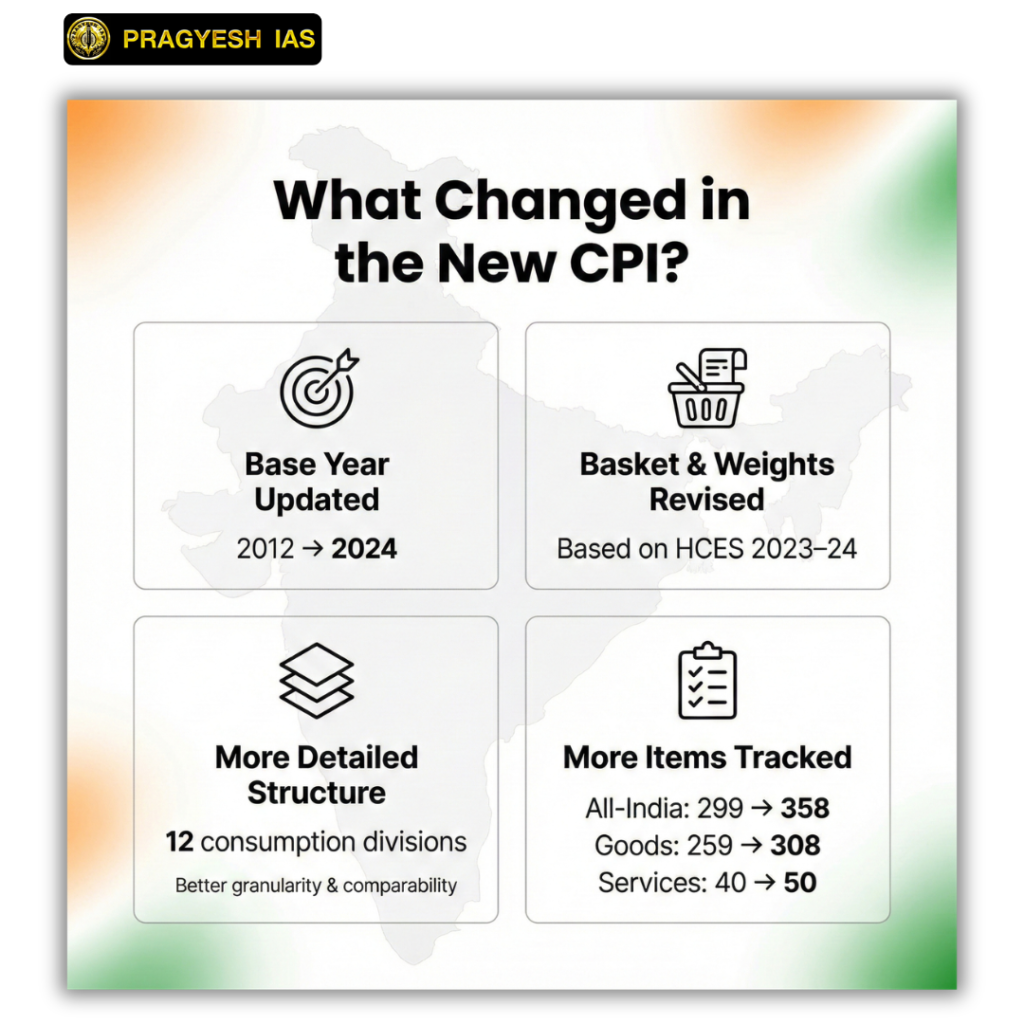
- What’s new: COICOP 2018 adoption, 12 divisions, broader basket (358 items), stronger services capture.
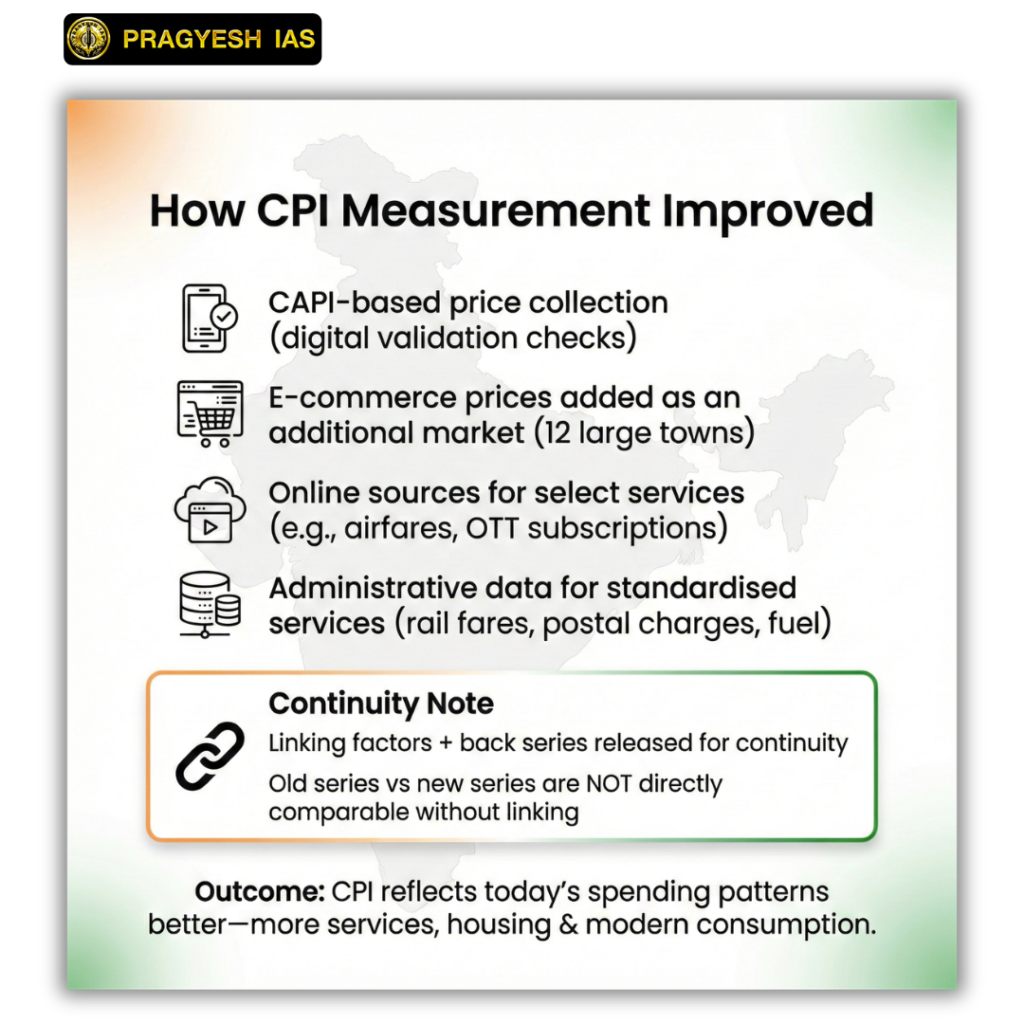
- Digital upgrade: CAPI collection + online market tracking + admin digital sources for better quality.
Current Data Point:
Jan 2026 CPI inflation = 2.75% (Combined) under the new base.
Ratio: What Changed Structurally (The 4A Lens)
1. Architecture (Classification Upgraded)
India has adopted COICOP 2018 (UN classification). Instead of the older “6 broad groups,” CPI 2024 is organized into 12 divisions (plus deeper groups/classes).
Why it matters: Improves granularity and global comparability—a clean Prelims fact.
2. Additions (Basket Expanded)
- Goods: 259 → 308
- Services: 40 → 50
Why it matters: A quiet but important signal that CPI now captures India’s more service-heavy lifestyle.
3. Accuracy (Modern Price Capture)
Price collection is now “Modern India” ready:
- Replaced paper with tablet-based CAPI.
- Integrates prices from 12 online markets across 12 major towns.
- Uses digital/administrative sources for standardized items (OTT, Rail/Air fare, Fuel, etc.).
The old CPI (2012 base) and new CPI (2024 base) are not directly comparable.
How it works: MoSPI provides a “linking-factor approach” and back-series using an overlap period to ensure continuity for analysis.
Scope: The Great Weight Shift (Why UPSC Should Care)
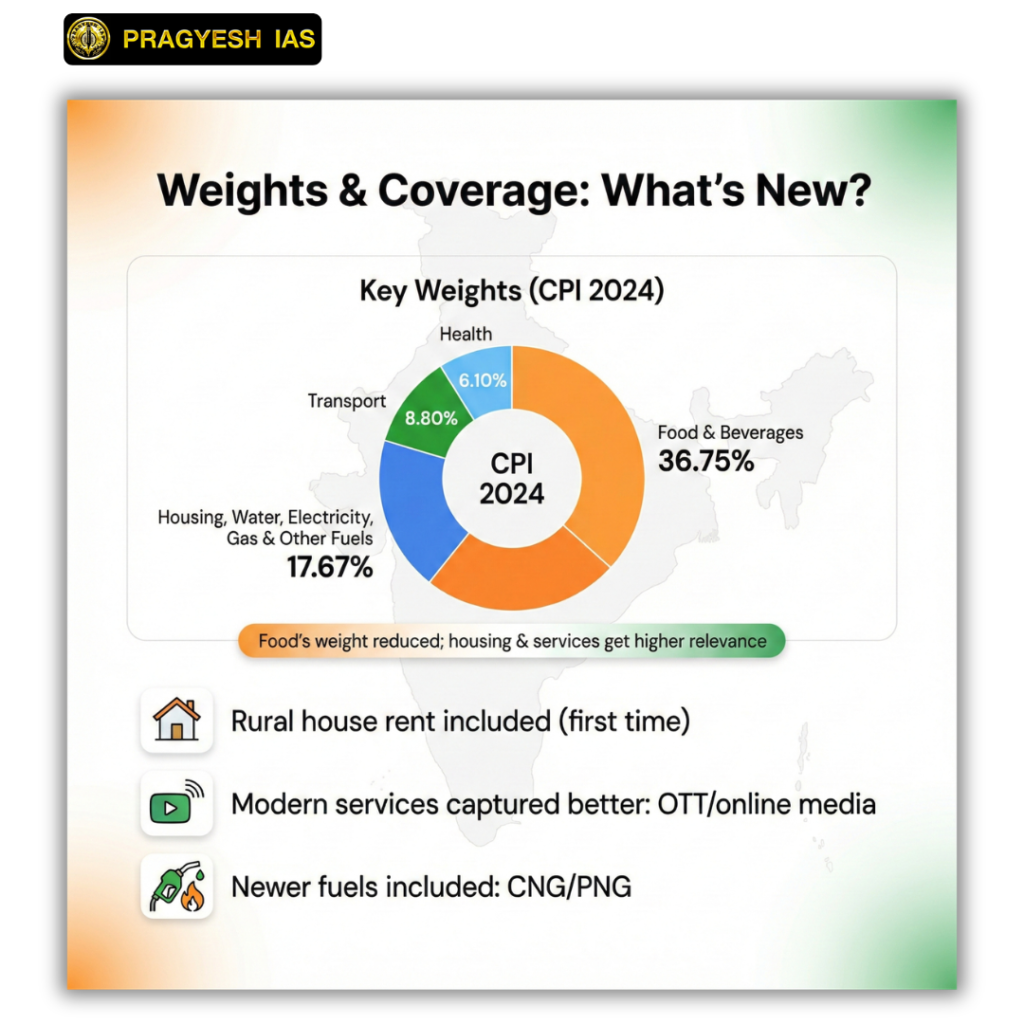
The headline takeaway is: food still matters most, but it dominates less than before. As per reporting around the revision, food’s weight has been reduced from 45.86% to 36.75%, making headline inflation potentially less whipsawed by food shocks.
[VISUALIZATION: THE FOOD WEIGHT DROP]
“New India Consumption” shows up here:
- The revision includes first-time rural house rent.
- Strengthened representation of modern items like online media/streaming services (OTT) and fuels like CNG/PNG.
The Verdict (In Mains Language)
“CPI 2024 is best presented as a methodological strengthening: it updates the ‘mirror’ through which we measure cost-of-living—shifting from a 2012-era spending reality to a more services-, rent-, and digital-consumption-aware index, while preserving continuity through linking and back-series.”