
Gandhian Philosophy Notes for UPSC & BPSC | Pragyesh IAS
Gandhian philosophical thought begins as a lived pursuit of Truth (Satya), where ethics is not private virtue but the very foundation of public action. Its governing discipline is Ahimsa (Non-violence)—not passivity, but moral strength that refuses to defeat injustice by becoming unjust. From this union emerges Satyagraha, the distinctive Gandhian method of struggle: steadfastness in truth, willing acceptance of suffering, and the effort to convert the opponent rather than coerce or humiliate.
For Gandhi, freedom is meaningful only when means and ends are inseparable: impure methods cannot yield a just society. This deepens the idea of Swaraj beyond political independence into self-rule—mastery over desire, fear, and hatred—so that a free nation is also a morally responsible one. In everyday life, Gandhi translates these ideals into Swadeshi and Khadi, linking nationalism to dignity of labour and self-reliance. The social goal is Sarvodaya—the welfare of all, with a constant priority for Antyodaya, the uplift of the last person. Held together by the Constructive Programme (and the educational vision of Nai Talim), Gandhian thought ultimately reads as an integrated moral politics: Satya as compass, Ahimsa as method, Satyagraha as practice, Swaraj as freedom-with-self-discipline, and Sarvodaya as the horizon of justice.
Satya (Truth)
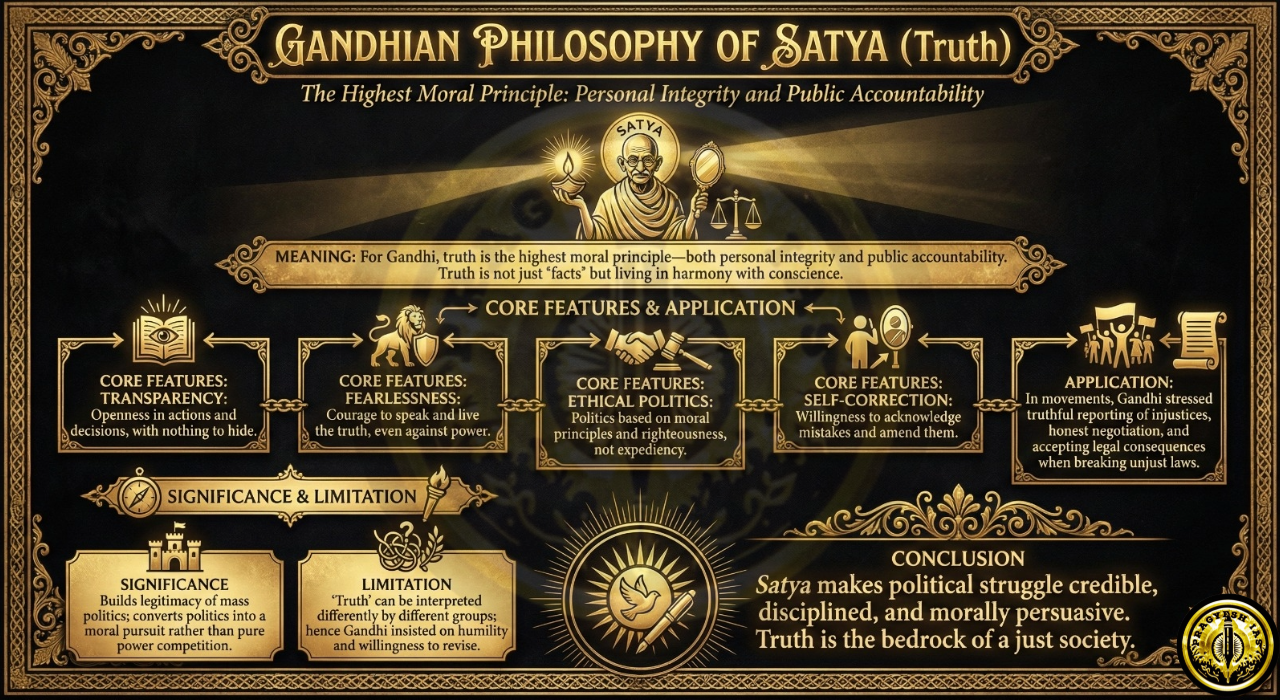
Meaning: For Gandhi, truth is the highest moral principle—both personal integrity and public accountability. Truth is not just “facts” but living in harmony with conscience.
Core features: transparency, fearlessness, ethical politics, self-correction.
Application: In movements, Gandhi stressed truthful reporting of injustices, honest negotiation, and accepting legal consequences when breaking unjust laws.
Significance: Builds legitimacy of mass politics; converts politics into a moral pursuit rather than pure power competition.
Limitation: “Truth” can be interpreted differently by different groups; hence Gandhi insisted on humility and willingness to revise.
Mains conclusion: Satya makes political struggle credible, disciplined, and morally persuasive.
Ahimsa (Non-violence)
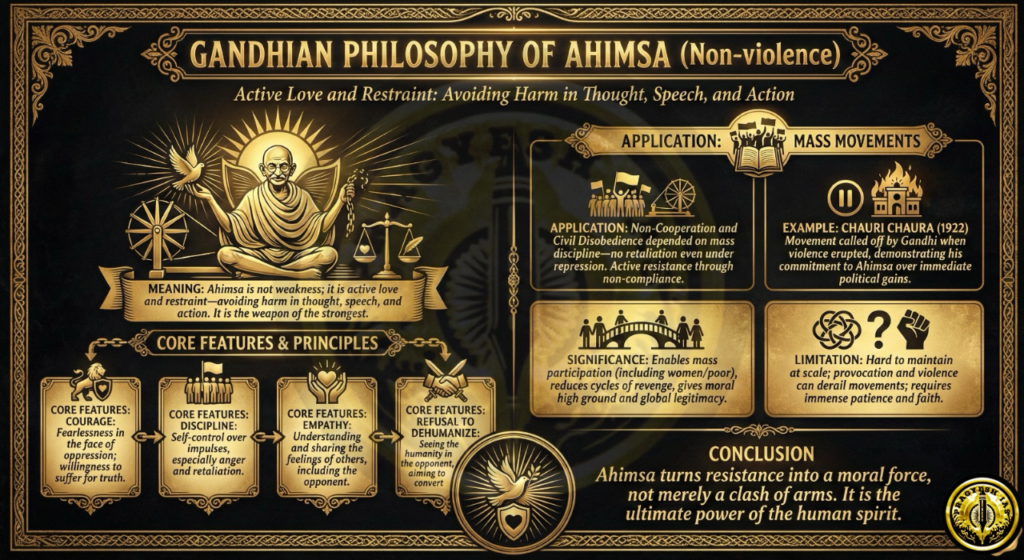
Meaning: Ahimsa is not weakness; it is active love and restraint—avoiding harm in thought, speech, and action.
Core features: courage, discipline, empathy, refusal to dehumanize the opponent.
Application: Non-Cooperation and Civil Disobedience depended on mass discipline—no retaliation even under repression.
Significance: Enables mass participation (including women/poor), reduces cycles of revenge, gives moral high ground.
Limitation: Hard to maintain at scale; provocation and violence can derail movements (e.g., Chauri Chaura).
Conclusion: Ahimsa turns resistance into a moral force, not merely a clash of arms.
Satyagraha (Truth-force)
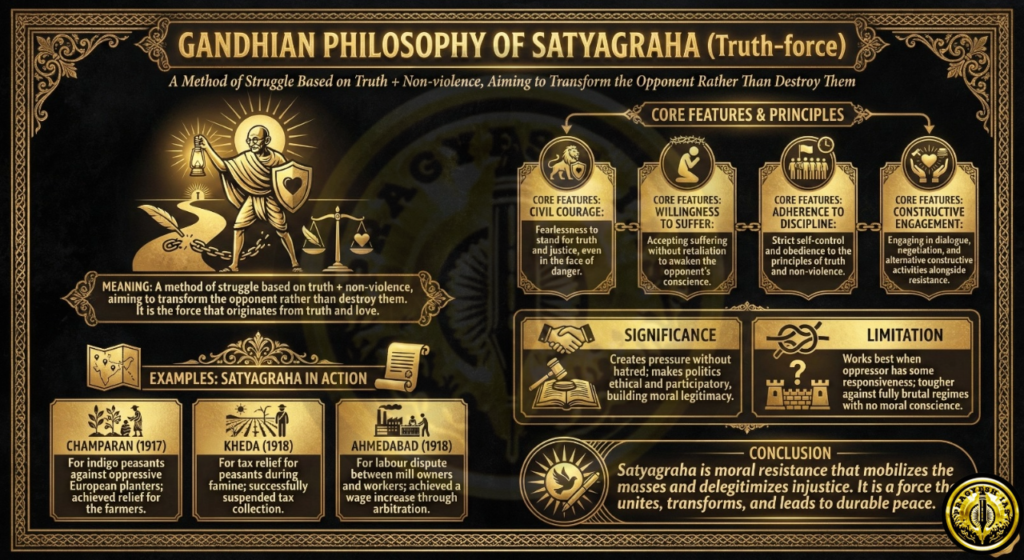
Meaning: A method of struggle based on truth + non-violence, aiming to transform the opponent rather than destroy them.
Core features: civil courage, willingness to suffer, adherence to discipline, constructive engagement.
Examples: Champaran (1917) for indigo peasants; Kheda (1918) tax relief; Ahmedabad (1918) labour dispute.
Significance: Creates pressure without hatred; makes politics ethical and participatory.
Limitation: Works best when oppressor has some responsiveness; tougher against fully brutal regimes.
Conclusion: Satyagraha is moral resistance that mobilizes the masses and delegitimizes injustice.
Unity of Ends and Means
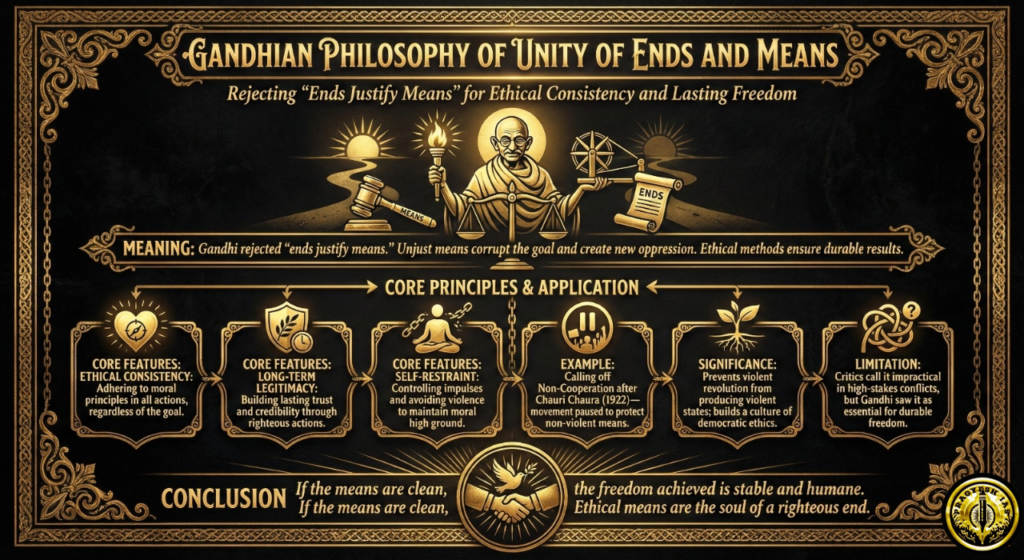
Meaning: Gandhi rejected “ends justify means.” Unjust means corrupt the goal and create new oppression.
Core features: ethical consistency, long-term legitimacy, self-restraint.
Example: Calling off Non-Cooperation after Chauri Chaura (1922)—movement paused to protect non-violent means.
Significance: Prevents violent revolution from producing violent states; builds a culture of democratic ethics.
Limitation: Critics call it impractical in high-stakes conflicts, but Gandhi saw it as essential for durable freedom.
Conclusion: If the means are clean, the freedom achieved is stable and humane.
Swaraj (Self-rule)
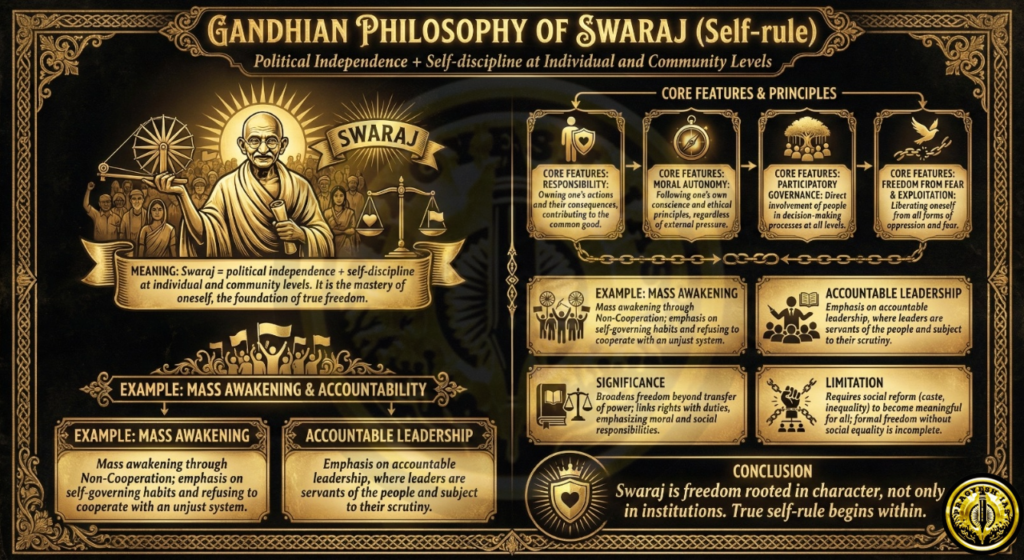
Meaning: Swaraj = political independence + self-discipline at individual and community levels.
Core features: responsibility, moral autonomy, participatory governance, freedom from fear and exploitation.
Example: Mass awakening through Non-Cooperation; emphasis on self-governing habits and accountable leadership.
Significance: Broadens freedom beyond transfer of power; links rights with duties.
Limitation: Requires social reform (caste, inequality) to become meaningful for all.
Conclusion: Swaraj is freedom rooted in character, not only in institutions.
Swadeshi
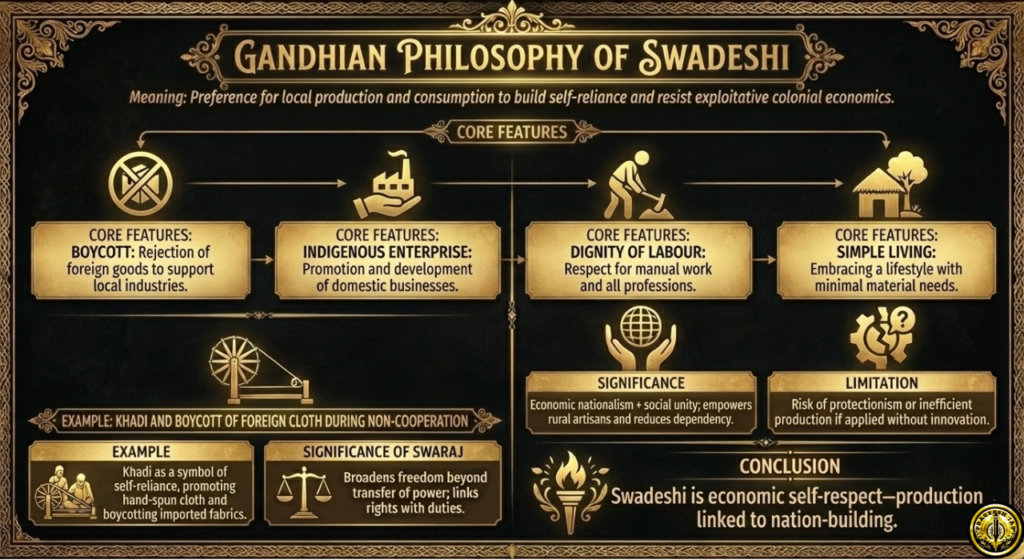
Meaning: Preference for local production and consumption to build self-reliance and resist exploitative colonial economics.
Core features: boycott, indigenous enterprise, dignity of labour, simple living.
Example: Khadi and boycott of foreign cloth during Non-Cooperation.
Significance: Economic nationalism + social unity; empowers rural artisans and reduces dependency.
Limitation: Risk of protectionism or inefficient production if applied without innovation.
Conclusion: Swadeshi is economic self-respect—production linked to nation-building.
Sarvodaya (Welfare of All)
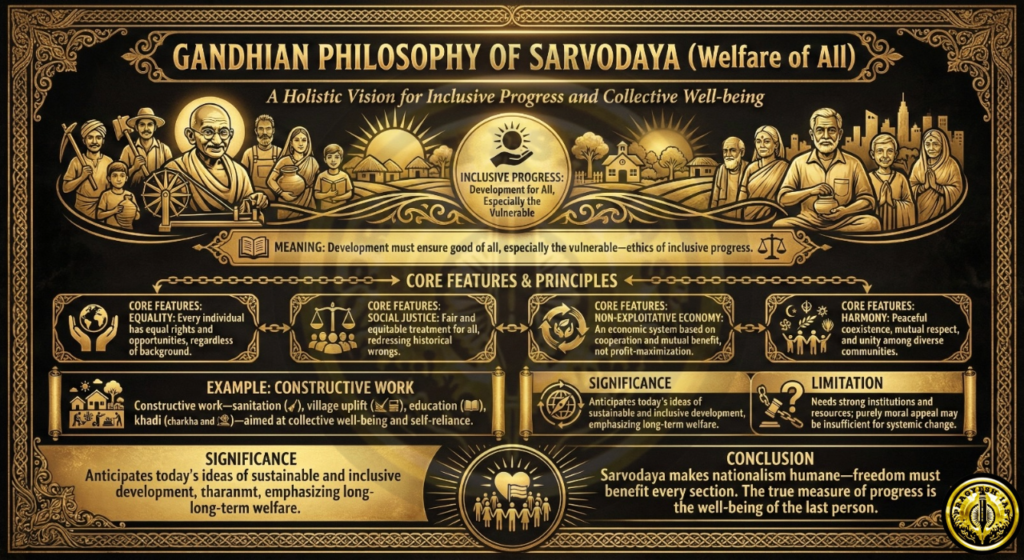
Meaning: Development must ensure good of all, especially the vulnerable—ethics of inclusive progress.
Core features: equality, social justice, non-exploitative economy, harmony.
Example: Constructive work—sanitation, village uplift, education, khadi—aimed at collective well-being.
Significance: Anticipates today’s ideas of sustainable and inclusive development.
Limitation: Needs strong institutions and resources; purely moral appeal may be insufficient.
Conclusion: Sarvodaya makes nationalism humane—freedom must benefit every section.
Antyodaya (Last Person First)
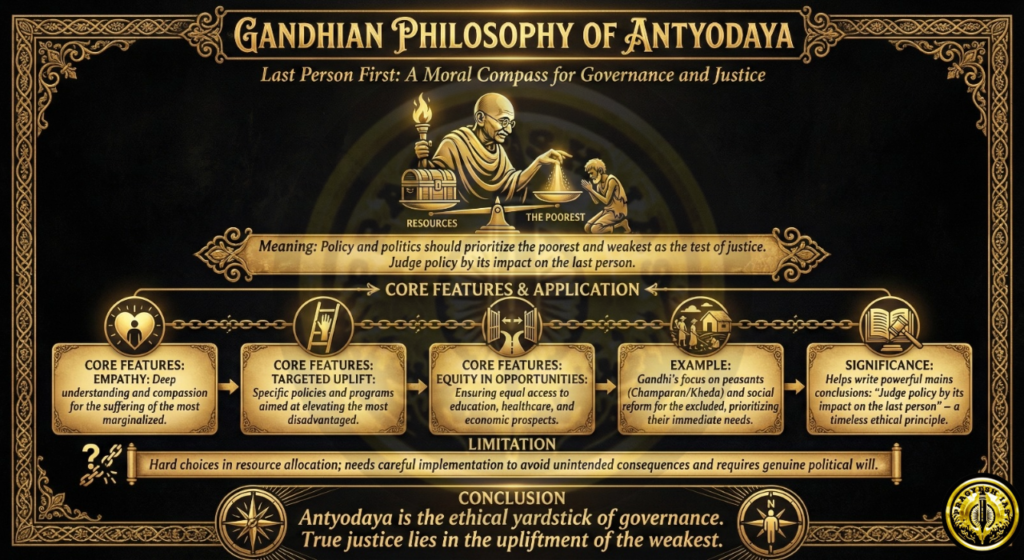
Meaning: Policy and politics should prioritize the poorest and weakest as the test of justice.
Core features: empathy, targeted uplift, equity in opportunities.
Example: Gandhi’s focus on peasants (Champaran/Kheda) and social reform for the excluded.
Significance: Helps write powerful mains conclusions: “judge policy by its impact on the last person.”
Limitation: Hard choices in resource allocation; needs careful implementation.
Conclusion: Antyodaya is the ethical yardstick of governance.
Trusteeship
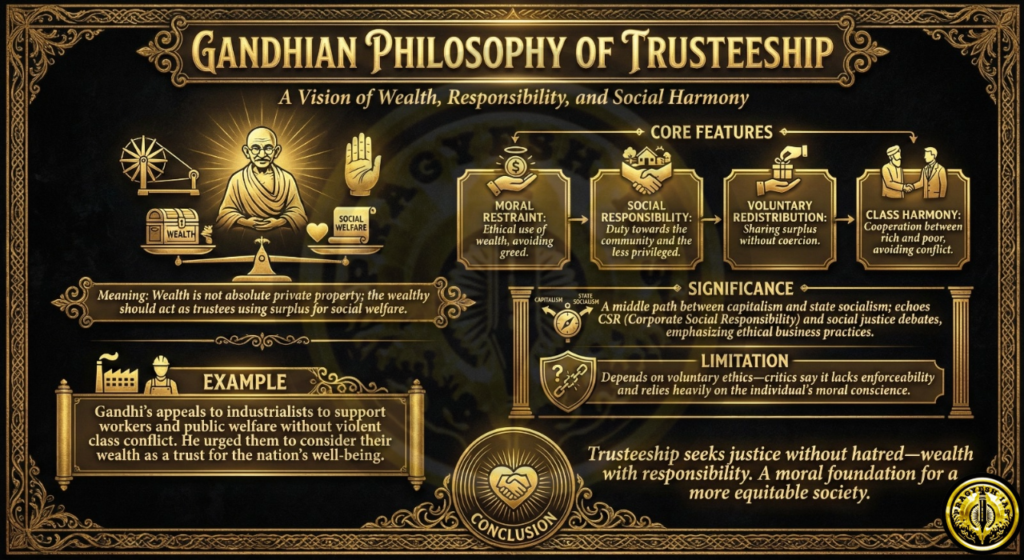
Meaning: Wealth is not absolute private property; the wealthy should act as trustees using surplus for social welfare.
Core features: moral restraint, social responsibility, voluntary redistribution, class harmony.
Example: Gandhi’s appeals to industrialists to support workers and public welfare without violent class conflict.
Significance: A middle path between capitalism and state socialism; echoes CSR/social justice debates.
Limitation: Depends on voluntary ethics—critics say it lacks enforceability.
Conclusion: Trusteeship seeks justice without hatred—wealth with responsibility.
Bread Labour (Sharir-Shram)
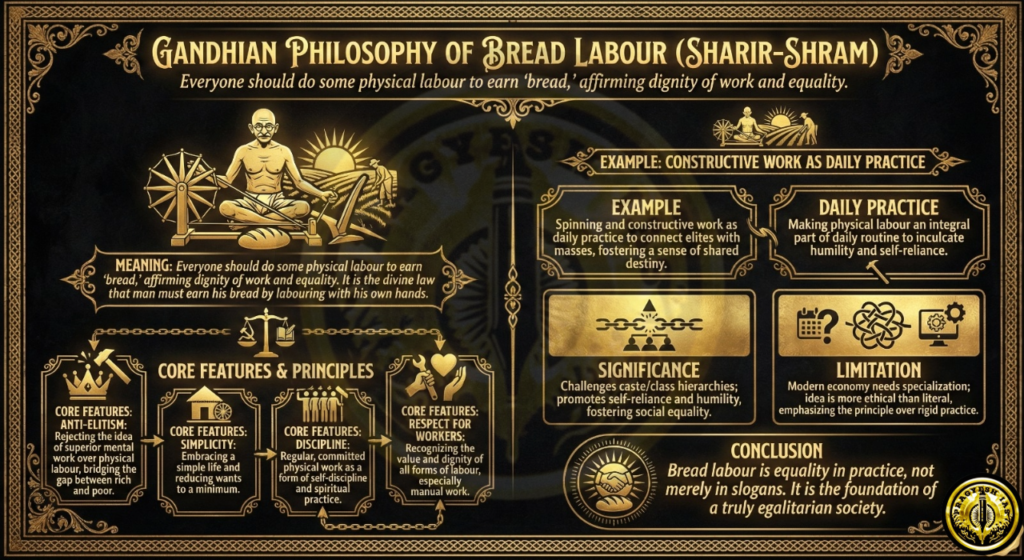
Meaning: Everyone should do some physical labour to earn “bread,” affirming dignity of work and equality.
Core features: anti-elitism, simplicity, discipline, respect for workers.
Example: Spinning and constructive work as daily practice to connect elites with masses.
Significance: Challenges caste/class hierarchies; promotes self-reliance and humility.
Limitation: Modern economy needs specialization; idea is more ethical than literal.
Conclusion: Bread labour is equality in practice, not merely in slogans.
Non-Cooperation
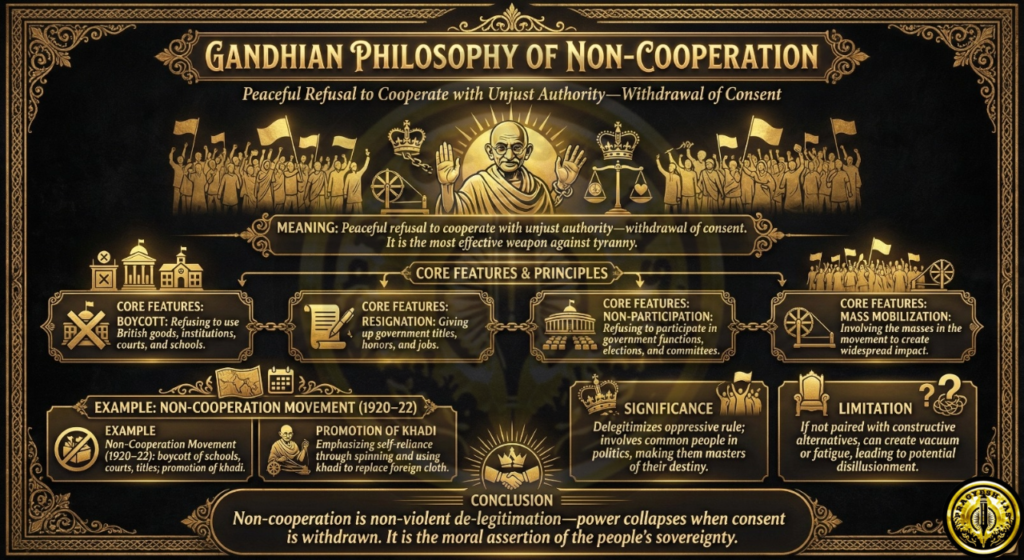
Meaning: Peaceful refusal to cooperate with unjust authority—withdrawal of consent.
Core features: boycott, resignation, non-participation, mass mobilization.
Example: Non-Cooperation Movement (1920–22): boycott of schools, courts, titles; promotion of khadi.
Significance: Delegitimizes oppressive rule; involves common people in politics.
Limitation: If not paired with constructive alternatives, can create vacuum or fatigue.
Conclusion: Non-cooperation is non-violent de-legitimation—power collapses when consent is withdrawn.
Civil Disobedience
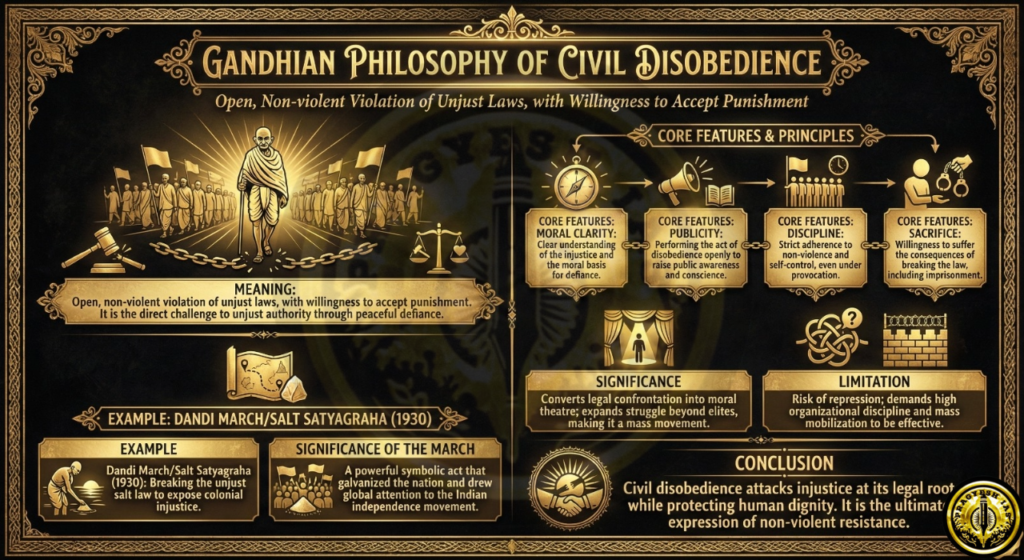
Meaning: Open, non-violent violation of unjust laws, with willingness to accept punishment.
Core features: moral clarity, publicity, discipline, sacrifice.
Example: Dandi March/Salt Satyagraha (1930)—breaking salt law to expose colonial injustice.
Significance: Converts legal confrontation into moral theatre; expands struggle beyond elites.
Limitation: Risk of repression; demands high organizational discipline.
Conclusion: Civil disobedience attacks injustice at its legal root while protecting human dignity.
Constructive Programme
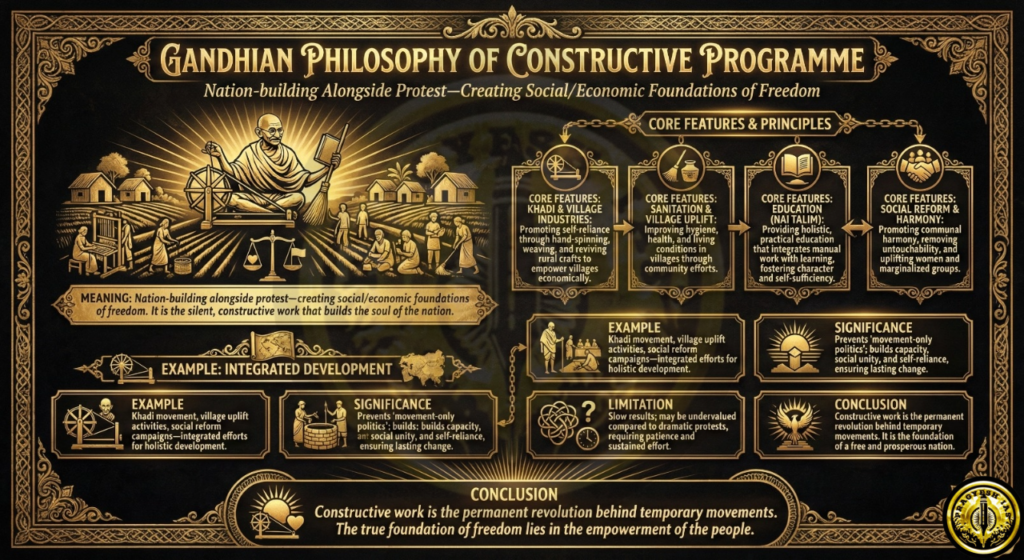
Meaning: Nation-building alongside protest—creating social/economic foundations of freedom.
Core features: khadi, village industries, sanitation, education, women’s uplift, communal harmony, removal of untouchability.
Example: Khadi movement, village uplift activities, social reform campaigns.
Significance: Prevents “movement-only politics”; builds capacity, social unity, and self-reliance.
Limitation: Slow results; may be undervalued compared to dramatic protests.
Conclusion: Constructive work is the permanent revolution behind temporary movements.
Gram Swaraj (Village Swaraj)
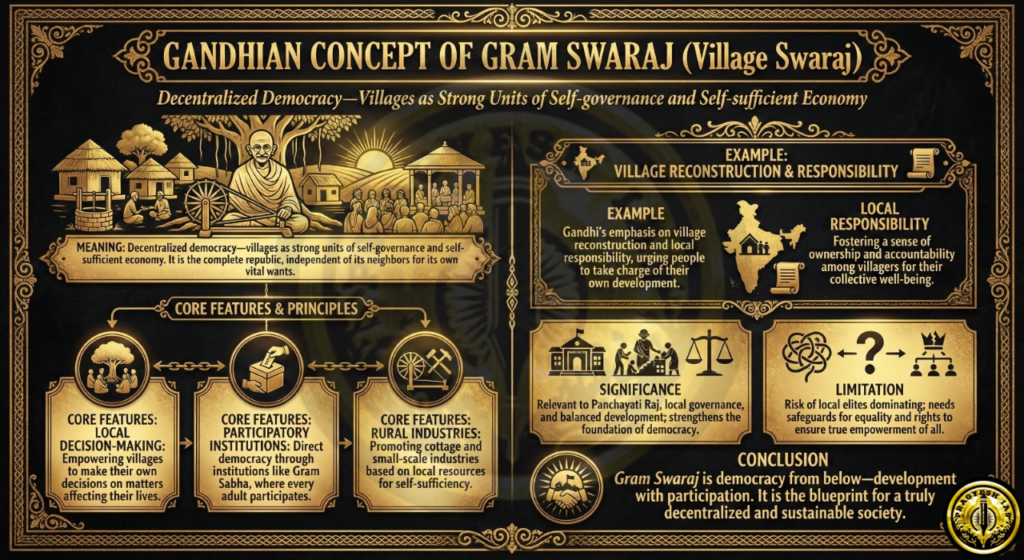
Meaning: Decentralized democracy—villages as strong units of self-governance and self-sufficient economy.
Core features: local decision-making, participatory institutions, rural industries.
Example: Gandhi’s emphasis on village reconstruction and local responsibility.
Significance: Relevant to Panchayati Raj, local governance, and balanced development.
Limitation: Risk of local elites dominating; needs safeguards for equality and rights.
Conclusion: Gram Swaraj is democracy from below—development with participation.
Nai Talim (Basic Education)
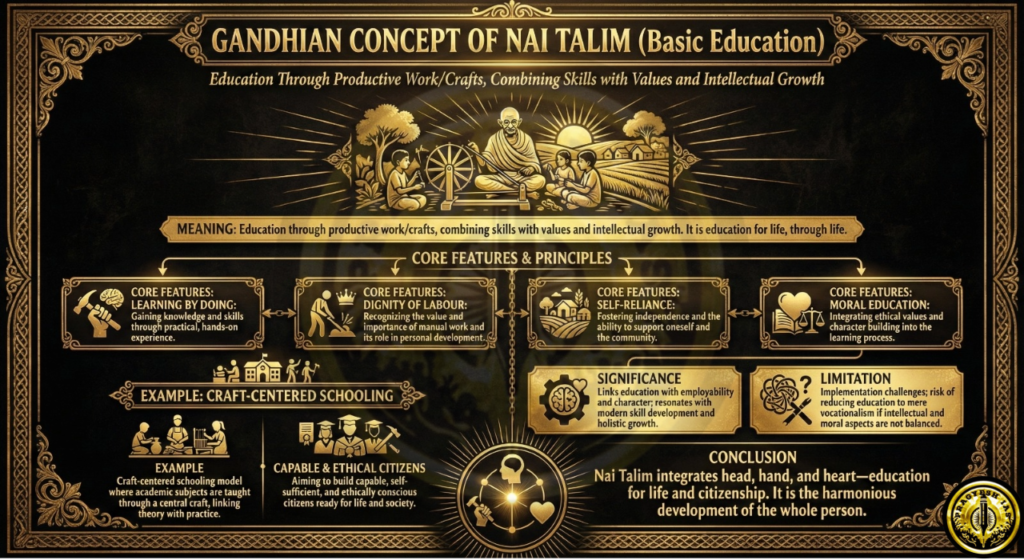
Meaning: Education through productive work/crafts, combining skills with values and intellectual growth.
Core features: learning by doing, dignity of labour, self-reliance, moral education.
Example: Craft-centered schooling model to build capable and ethical citizens.
Significance: Links education with employability and character; resonates with skill development.
Limitation: Implementation challenges; risk of reducing education to vocationalism if not balanced.
Conclusion: Nai Talim integrates head, hand, and heart—education for life and citizenship.
Communal Harmony & Religious Pluralism

Meaning: Equal respect for all faiths; politics must not become a tool of hatred.
Core features: tolerance, unity, dialogue, ethical nationalism.
Example: Gandhi’s interventions and appeals during communal tensions; insistence on shared civic identity.
Significance: Vital for social stability; strengthens democratic nationhood.
Limitation: Communal politics can overpower moral appeals; needs institutional protections too.
Conclusion: Harmony is not optional—without it, freedom becomes fragile.
Removal of Untouchability
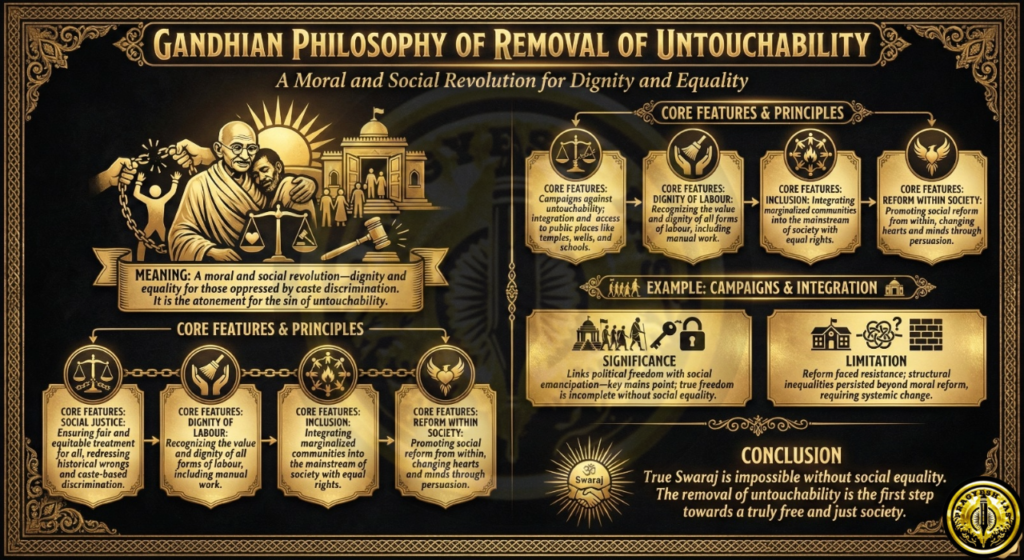
Meaning: A moral and social revolution—dignity and equality for those oppressed by caste discrimination.
Core features: social justice, dignity of labour, inclusion, reform within society.
Example: Campaigns against untouchability; promoting integration and equal access.
Significance: Links political freedom with social emancipation—key mains point.
Limitation: Reform faced resistance; structural inequalities persisted beyond moral reform.
Conclusion: True Swaraj is impossible without social equality.
Peaceful Conflict Resolution
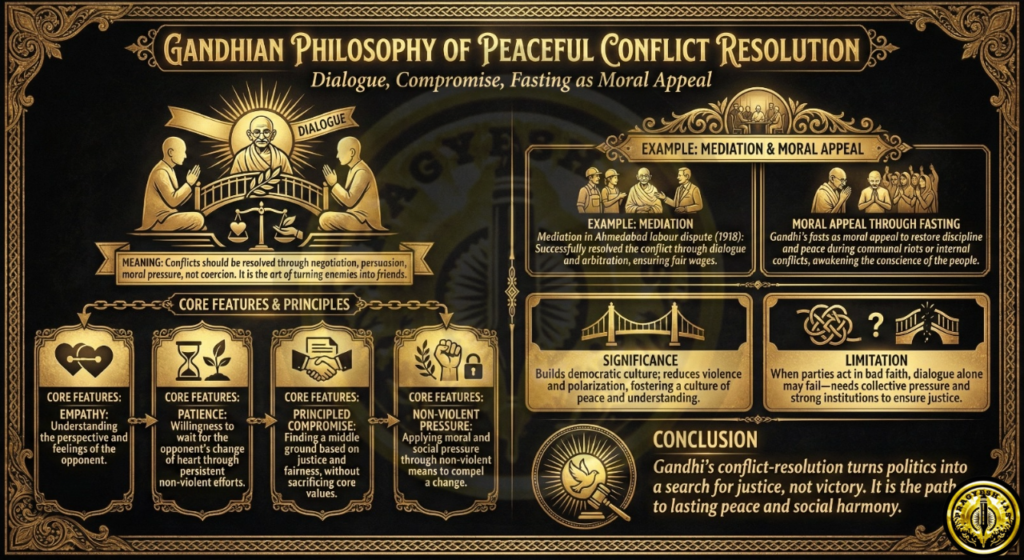
Meaning: Conflicts should be resolved through negotiation, persuasion, moral pressure, not coercion.
Core features: empathy, patience, principled compromise, non-violent pressure.
Example: Mediation in Ahmedabad labour dispute (1918); Gandhi’s fasts as moral appeal to restore discipline and peace.
Significance: Builds democratic culture; reduces violence and polarization.
Limitation: When parties act in bad faith, dialogue alone may fail—needs collective pressure and institutions.
Conclusion: Gandhi’s conflict-resolution turns politics into a search for justice, not victory.