Pragyesh IAS • Daily Current Affairs BPSC Daily Current Affairs...
Read More
16th Finance Commission Recommendation (2026–31)
Centre–State fiscal sharing, grants, local bodies, and fiscal discipline
States’ share in divisible pool
0
%
Total grants (2026–31) {Lac cr}
₹
0
.47
Contribution to GDP
0
%
Report submitted
0
Nov 2025
Report tabled
01 Feb
0
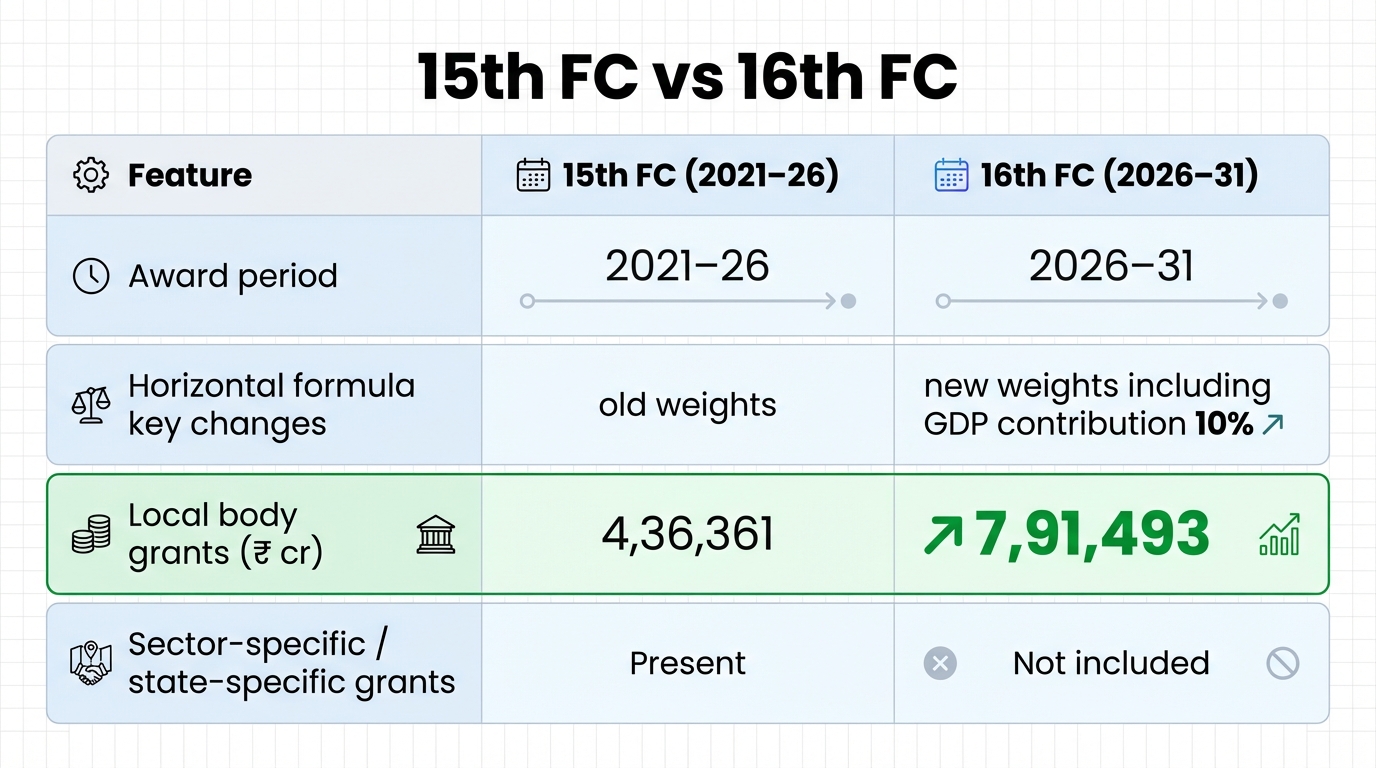
Award period
2026-
0
to 2030-31
“This page explains what the Finance Commission is, what the 16th FC recommended, and what changed vs the 15th FC.”
What is the Finance Commission?

- Constitutional body constituted by the President (typically every five years) to recommend Centre–State fiscal transfers.

- Recommends tax devolution + grants-in-aid + support to local bodies + other referred matters.

- Goal: reduce vertical & horizontal imbalances; strengthen cooperative federalism
Constitutional Basis
Article 280 — Finance Commission
- The President constitutes the Finance Commission.
- It recommends distribution of the net proceeds of taxes between Union and States and among States.
- It also recommends principles for grants-in-aid and measures to strengthen Panchayats and Municipalities.
Related provisions
Article 275 (grants-in-aid), Article 281 (report laid before Parliament), Article 279 (CAG-certified net proceeds transparency context), Article 293(3) (borrowing oversight context)
16th FC: Leadership & Timeline
16th FC at a Glance
- Constituted: 31 Dec 2023
- Report submitted to President: 17 Nov 2025
- Tabled in Parliament: 1 Feb 2026
- Award period: 2026–27 to 2030–31
16th FC at a Glance
- Chairman: Dr. Arvind Panagariya
- Members: Smt. Annie George Mathew (Full-time), Dr. Manoj Panda (Full-time), Dr. Soumya Kanti Ghosh (Part-time), Shri T. Rabi Sankar (Part-time)
- Secretary: Shri Ritvik Ranjanam Pandey
Tax Devolution (2026–31)
Tax devolution has two layers: how much goes to States (vertical), and how it’s shared among States (horizontal).
The Money Flow
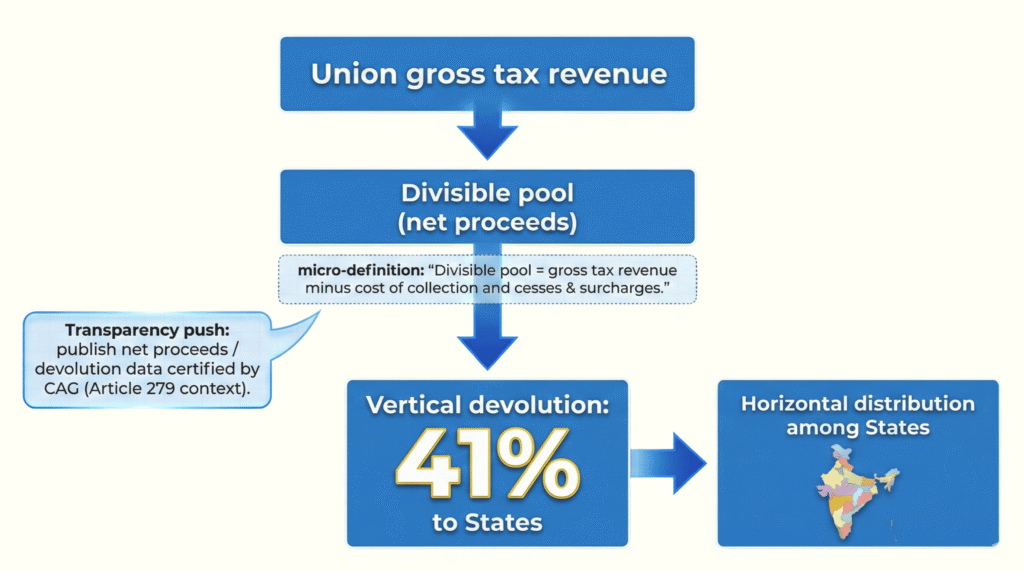
Transparency push: publish net proceeds / devolution data certified by CAG (Article 279 context).
Vertical Devolution
States' share in the divisible pool of Union taxes (2026-31)
0
%
This is the aggregate share for all States together.
Horizontal Devolution
- Income distance: Equity support for lower-income states.
- Population (2011): Current needs and scale.
- Demographic performance: Rewards better population outcomes.
- Area: Cost disabilities of size.
- Forest: Ecological services and conservation effort.
- Contribution to GDP: Recognises output contribution/performance.
16th FC vs 15th FC — Horizontal weights (%)
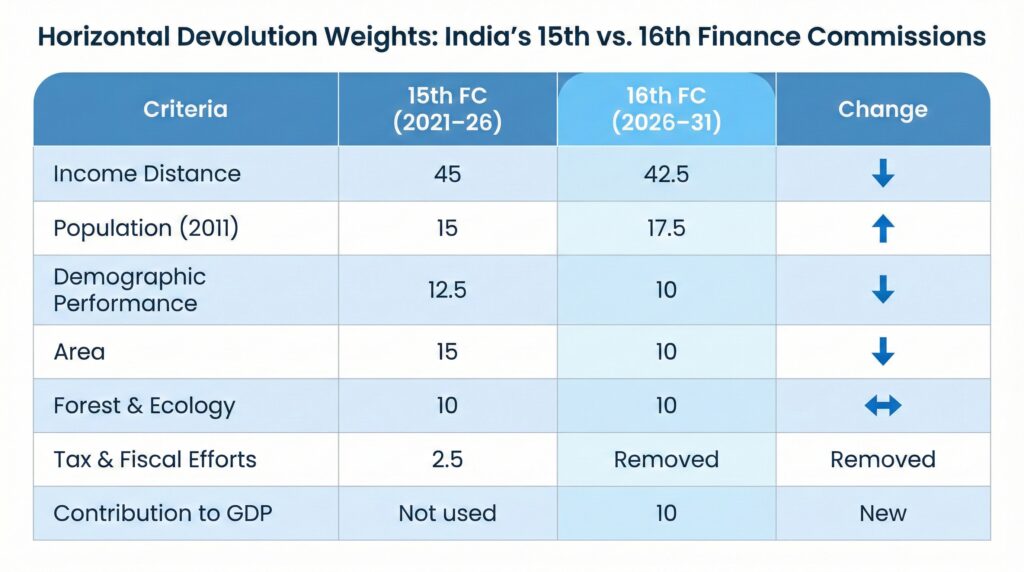
NEW: GDP contribution added
REMOVED: Tax & Fiscal Efforts
Shift: Population ↑, Area ↓
Grants-in-Aid (2026–31)
Total grants (2026–31) {Lac cr}
₹
0
.47
Local governments: ₹
0
crore
Disaster management: ₹
0
crore
Total: ₹
0
crore
What’s discontinued (clear “Not recommended” panel)?
“Not recommended by 16th FC:”
- Revenue deficit grants
- Sector-specific grants
- State-specific grants
“Focus shifts toward formula-based transfers and structured grant design.”
Local Government Grants: Structure & Rules
Rural Local Bodies (RLBs): ₹4,35,236 cr
- Basic: ₹3,48,188 cr
- Performance: ₹87,048 cr
Urban Local Bodies (ULBs): ₹3,56,257 cr
- Basic: ₹2,32,125 cr
- Performance: ₹58,032 cr
- Special Infrastructure Component: ₹56,100 cr (wastewater management)
- Urbanisation Premium: ₹10,000 cr (one-time)
How it’s structured?
- RLB : ULB (Basic+Performance combined) = 60 : 40
- Basic : Performance (both RLB & ULB) = 80 : 20
- 50% of Basic is tied (Sanitation/SWM and/or Water management)
Guardrails
- Untied grants not for salaries/establishment
- No local body spends > 20% of untied grants on roads
- Release in minimum two instalments yearly
- States transfer FC grants to local bodies within 10 working days (else interest)
Urbanisation Premium detail
- “₹2,000 per person (Census 2011 basis), linked to peri-urban village mergers into ULBs + rural-to-urban transition policy.”
Disaster management financing
State-level funds
State-level (SDRF + SDMF): ₹2,04,401 cr (2026–31)
- Union share: ₹1,55,915.85 cr | States: ₹48,485.15 cr
- Cost sharing: 75:25 (non-NEH) | 90:10 (NEH)
- Split: SDRF 80% (₹1,63,521 cr) | SDMF 20% (₹40,880 cr)
Condition: from 2027–28, states must complete NDMIS data feeding/validation by May 31 (succeeding year)
National-level funds
National-level (NDRF + NDMF): ₹79,406 cr (2026–31)
- Add graded contribution note: “10% up to ₹250 cr; 20% up to ₹500 cr; 25% above ₹500 cr (NEH: 10%).”
Fiscal Discipline & Reforms
States fiscal deficit cap: 3% of GSDP (with “Article 293(3) oversight” tag)
Union fiscal deficit target: 3.5% of GDP (by end of award period)
Off-budget borrowing
Before:
“Off-budget borrowings (hidden liabilities)”
After:
“Bring borrowings on-budget (transparent, accountable)”
FRL/FRBM alignment
- “Align State Fiscal Responsibility laws with the consolidation roadmap.”
- “Standardise reporting and close loopholes.”
Reform tiles (2×2)
- Centrally Sponsored Schemes: rationalise for efficiency
- Power sector reforms: improve governance, reduce leakages
- Subsidies: better targeting and containment
- PSUs/PSEs: performance and accountability reforms
What changed from the 15th to the 16th FC?