
Pragyesh IAS • Daily Current Affairs BPSC Daily Current Affairs...
Read MoreLord Cornwallis (1786–1793): Reforms, Mysore War, Legacy
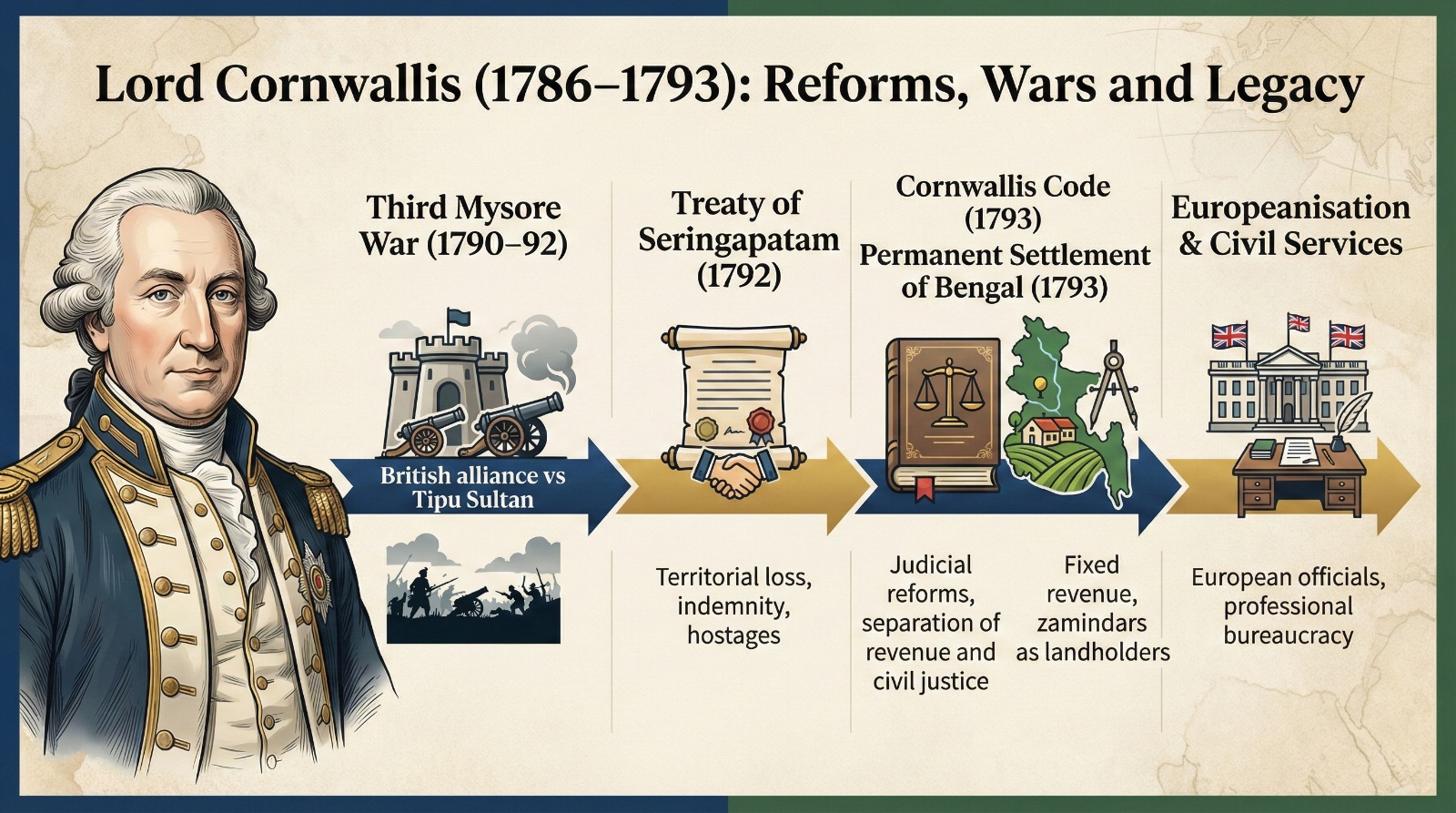
Profile & Background
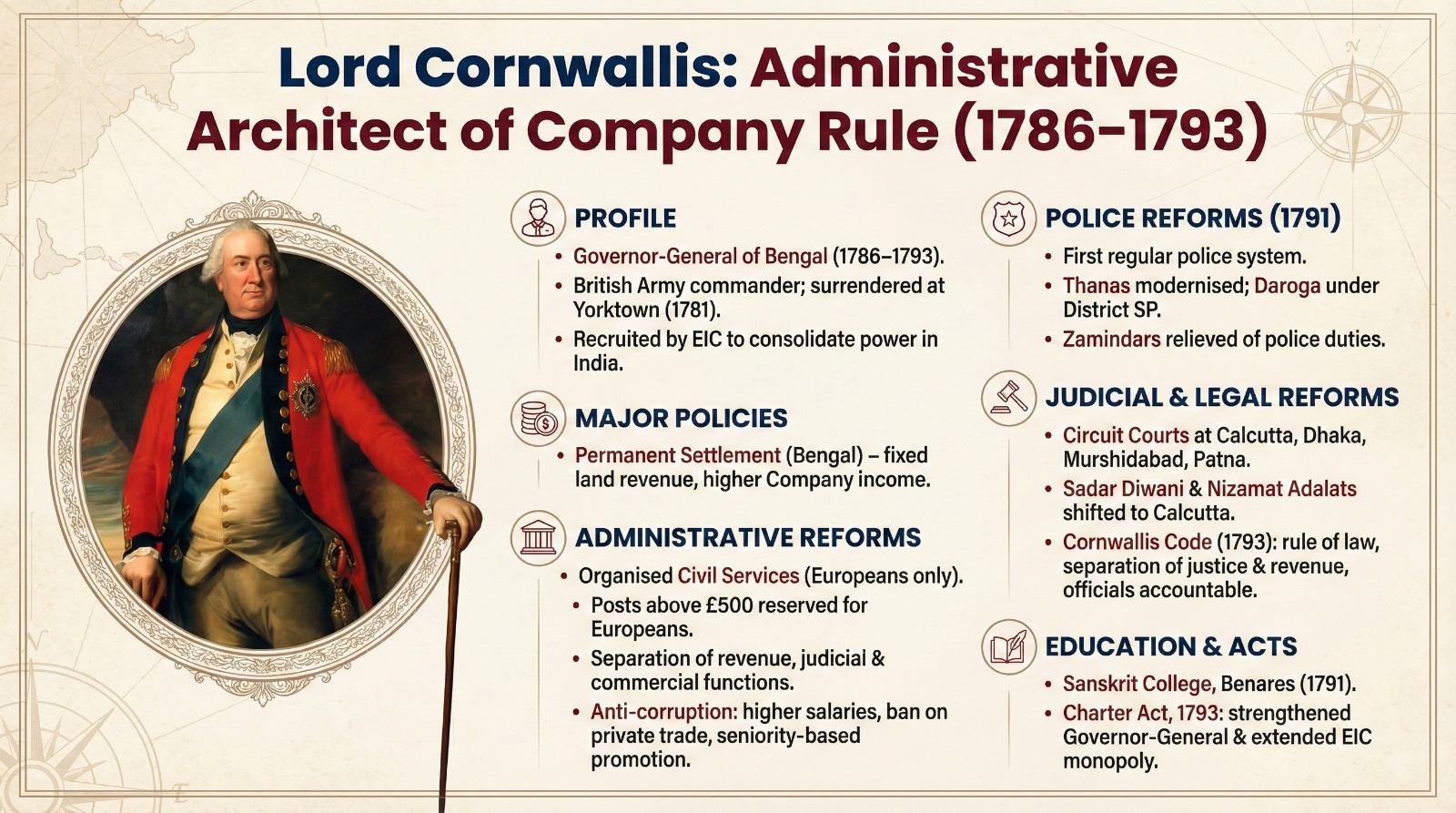
- Charles Cornwallis served as Governor-General of Bengal (1786–1793) and was also a senior British Army commander.
- The East India Company (EIC) appointed him in India to strengthen and consolidate its political–military control.
- Known as a reform-oriented administrator.
- He is remembered in North American history for the surrender at Yorktown (1781) to combined American and French forces.
Major Revenue Policy
Permanent Settlement-1793 (Bengal)
- Introduced the Permanent Settlement, aimed at stabilising land revenue and increasing Company income in Bengal.
Wars & Diplomacy
Third Anglo–Mysore War (1790–1792)
- Cornwallis played a leading role in the Company’s victory over Tipu Sultan.
- The war ended with the Treaty of Seringapatnam (1792).
Civil Service & Administrative Reforms
Civil Services Organisation
- Cornwallis systematised and organised the Company’s civil administration (often linked with the “Cornwallis reforms”).
European Monopoly in Higher Services
- Recruitment to higher civil posts was restricted to Europeans, reflecting distrust of Indians in top administration.
- Senior Indian officials were removed, and high-value posts were closed to them.
- Positions above £500 per year were reserved for Europeans.
Separation of Functions (Checks & Balance)
- Introduced clearer separation between commercial, judicial, and revenue roles.
- Collectors lost judicial authority and were confined mainly to revenue duties.
Anti-Corruption Measures
- Sought to curb corruption by:
- Raising salaries of Company servants to reduce the lure of private trade.
- Strictly enforcing the ban on private trade.
- Taking action against officials accepting bribes, gifts, and “presents.”
- Making seniority the main basis for promotions to reduce favouritism.
Police Reforms
Background (Before Cornwallis)
- Pre-colonial India did not have a modern police structure; under later Mughals:
- Faujdars handled law and order (largely rural/territorial).
- Kotwal managed city policing and order.
- Amils were revenue officials.
- During Dual Government (1765–1772), zamindars maintained thanedars, but dereliction of duties led to rising dacoity.
Regular Police Force (1791)
- Cornwallis established a regular police system (1791).
- The thana (police circle) system was modernised.
- Each thana was placed under a Daroga (Indian).
- District-level supervision came under a Superintendent of Police (SP).
- Zamindars were relieved of police responsibilities; control shifted towards judicial authorities (district judge).
Law Reforms
Cornwallis Code (1793)
- Introduced major legal principles and administrative restructuring:
- Separation of revenue and judicial administration
- European subjects brought under jurisdiction (greater uniformity)
- Government officials made answerable to civil courts for acts done in official capacity
- Emphasised the sovereignty of law
- Hindu and Muslim laws were separately compiled/codified for use in courts
Sanskrit College (1791)
- Jonathan Duncan founded the Sanskrit College at Benares (1791) to promote study of Hindu law and philosophy.
Charter Act of 1793 (Key Provisions)
- Renewed the EIC trade monopoly in India for 20 more years.
- Provided that the Board of Control members and staff would be paid from Indian revenues.
- Extended Cornwallis-style overriding authority: the Governor-General’s overriding power over his Council was extended to future Governor-Generals and Governors of Presidencies.
- Strengthened the Governor-General’s control over Bombay and Madras presidencies.
- Made the Commander-in-Chief ineligible for Council membership unless specifically appointed (as GG).
Judicial Reforms (Criminal and Civil)
Criminal Justice Changes
- District Faujdari courts with Indian judges were abolished.
- Four Circuit Courts were set up at Calcutta, Dhaka, Murshidabad, and Patna, staffed by European judges.
- Circuit courts acted as appellate courts for civil and criminal matters.
- The highest level of this circuit system was centred at Calcutta.
- Sadar Nizamat Adalat was shifted to Calcutta.
Civil Justice Changes
- The Diwani Adalats introduced earlier were reorganised and renamed as District/City/Zila Courts.
- These courts were placed under a District Judge.
- The Collector was confined to revenue collection only (no magisterial/judicial role).
- Appeals from district courts continued to go to the Sadar Diwani Adalat (also shifted to Calcutta).
Top Judicial Authority
- The Governor-General and Council were to preside over:
- Sadar Diwani Adalat
- Sadar Nizamat Adalat (assisted by Chief Qazi and Chief Mufti)
Hierarchy of Civil Courts (Gradation)
- Courts under Indian officers
- Courts under a European judge
- District Court under the District Judge
- Four Circuit Courts (Provincial Courts of Appeal)
- Sadar Diwani Adalat, Calcutta
- King-in-Council (appeals of £5000+)