
Pragyesh IAS • Daily Current Affairs BPSC Daily Current Affairs...
Read MoreWarren Hastings (1773–1785): Acts, Wars and Legacy
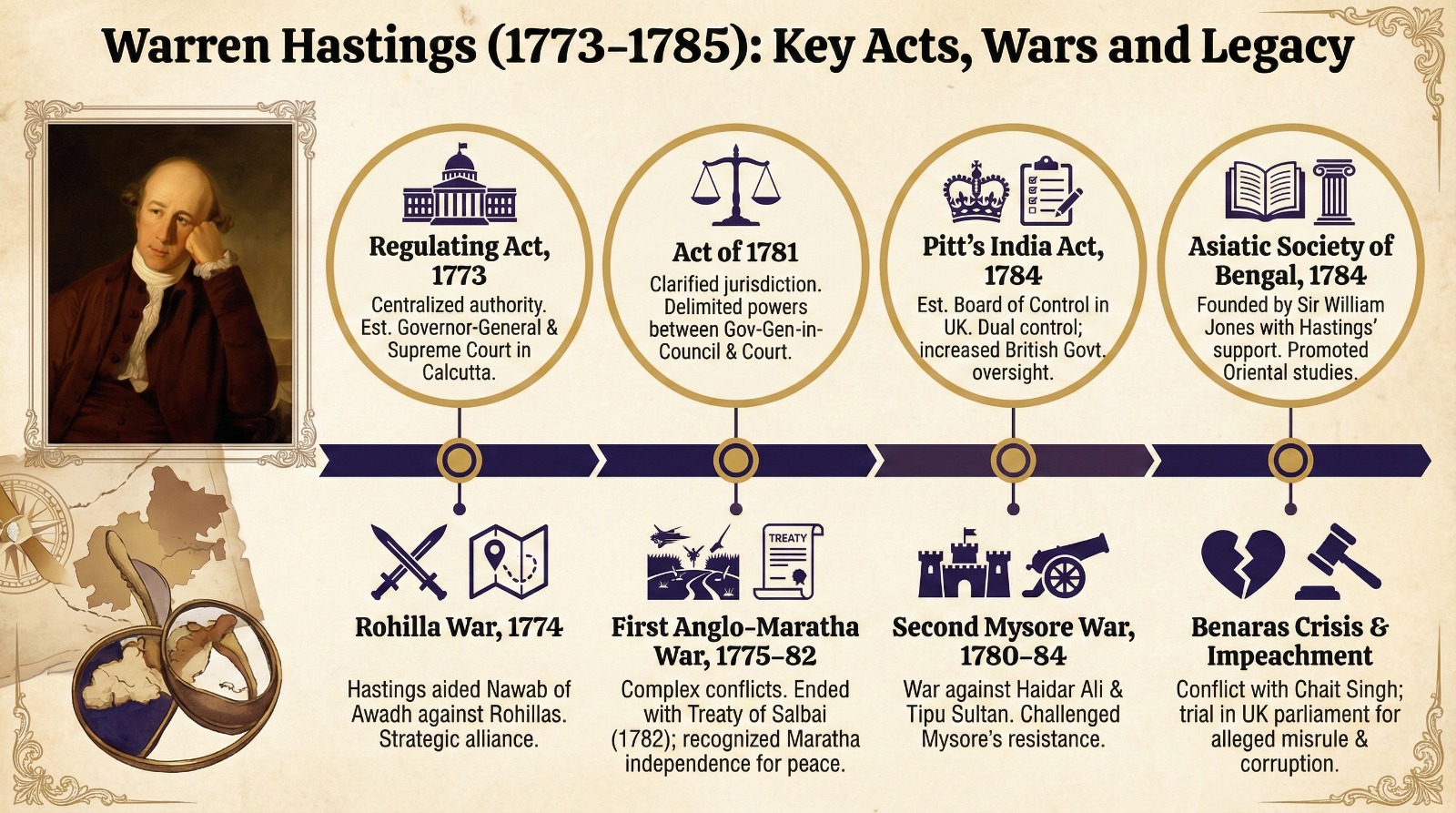
Explore Warren Hastings’ tenure (1773–85), key acts like the Regulating Act and Pitt’s India Act, major wars, impeachment, and lasting legacy.
Warren Hastings (1773–1785): Key Acts, Wars and Legacy
Warren Hastings served as the first Governor-General of Bengal during a decisive phase in early British rule in India. His tenure from 1773 to 1785 is remembered for two parallel developments: British Parliament tightened control over the East India Company, and the Company expanded its political and military footprint through wars, alliances, and revenue pressure. Hastings helped shape the foundations of colonial governance, but also faced strong criticism that ended in his impeachment trial in England.
Revenue & Fiscal Reforms (Bengal)
- Ended the Dual System (Bengal): Abolished the Company’s indirect revenue arrangement and placed revenue administration directly under Company control.
- Stopped the Nawab’s pension: Discontinued the annual pension to the Nawab, strengthening Company’s financial dominance.
- Stopped Mughal Emperor’s pension: Withdrew the ₹26 lakh annual pension to the Mughal emperor after Shah Alam II was freed from Allahabad Fort with the help of Mahadji Scindia.
- Board of Revenue & Collectors: Set up the Board of Revenue and appointed Collectors and other officials to streamline revenue collection and supervision.
- Lease/Itaredari system: Introduced a 5-year land revenue lease system in Bengal, where leases were given through auctions to the highest bidder.
- Currency standardisation: Worked towards a more uniform currency system to improve administration and trade efficiency.
Administrative Reorganisation
- Capital shift to Calcutta (1772): Declared Calcutta as the capital of Bengal and shifted the treasury there to centralise governance.
Legal & Judicial Measures
- Codification of laws: Ordered the compilation/codification of Hindu laws and preparation of digests of Muslim law texts for use in courts and administration.
Communication & Infrastructure
- Postal reforms: Developed a more efficient postal system to strengthen governance and information flow.
Scientific Survey & Knowledge Mapping
Support to James Rennell: Encouraged systematic mapping by backing James Rennell’s cartographical survey, improving the Company’s geographic and administrative understanding of India.
Famine Prevention & Public Welfare
Public granaries: Built state-supported granaries, including the Great Gola at Patna, to reduce the risk of famines like 1770–71 recurring.
Trade & Commercial Regulations
- Abolition of dastaks (free passes): Ended the misuse of dastaks, curbing unfair duty-free trade privileges and bringing greater control over internal trade.
- Uniform tariff policy: Introduced a uniform customs duty of 2.5% on goods, applicable to both Indian and European traders, to reduce discrimination.
Education, Culture & Orientalist Institutions
- Calcutta Madrasa (1781): Founded the Calcutta Madrasa to promote Islamic/Oriental learning (Arabic–Persian studies); among the earliest Company-era educational institutions.
- Asiatic Society of Bengal (1784): Set up by Sir William Jones to promote research in Indian/Asian languages, history, society, and culture.
- Gita in English: Charles Wilkins translated the Bhagavad Gita into English, expanding European access to Indian philosophical literature.
Judicial Reforms under Warren Hastings
- Establishment of District Courts: Warren Hastings set up separate civil and criminal courts in each district of Bengal to ensure systematic administration of justice.
- Civil Courts (Diwani Adalats): Diwani courts were instituted to deal with civil cases, particularly matters related to revenue, property, and contracts.
- Criminal Courts (Faujdari Adalats): Faujdari courts were created to handle criminal cases, maintaining law and order.
- Appellate System: A structured system of appellate courts was introduced, allowing appeals against district-level judicial decisions and strengthening judicial oversight.
Legislative Measures under Warren Hastings (1772–1785)
Regulating Act of 1773: Start of Parliamentary Control
The Regulating Act of 1773 was the first major intervention by the British Parliament to regulate the East India Company’s growing power. It was driven by concerns about corruption, mismanagement, and unchecked authority.
Key outcomes:
- Created the post of Governor-General of Bengal, with Hastings as the first.
- Set up an executive council to check the Governor-General.
- Established the Supreme Court at Calcutta (1774). (1 Chief Justice + 3 Judges). Eliza Impay, first Chief Justice of the Supreme Court.
- Resulted in jurisdiction conflicts because boundaries between Court and Company administration were unclear.
- No private trade or any Gift/Cash acceptance by any officer of the EIC (including Governor General, Council members, Supreme Court members).
Act of 1781: Fixing the Jurisdiction Crisis
The Supreme Court vs Company administration conflict caused serious disruption, especially in revenue and governance matters.
Key outcomes:
- The Act of 1781 clearly divided powers between the Governor-General-in-Council and the Supreme Court.
- Reduced the Court’s interference in revenue administration.
- Made colonial governance more stable and workable, while also strengthening Company authority.
Pitt’s India Act of 1784: Stronger British Government Oversight
The Pitt’s India Act (1784) further increased Britain’s control by introducing dual control.
Key outcomes:
- The Company handled commerce and routine administration.
- The British government supervised political and military affairs.
- Board of Control Established: A Board of Control was created with 6 members appointed by the British Crown to supervise Company affairs. Dual Governance Structure: It functioned alongside the Court of Directors, creating a system of shared authority over the East India Company.
- Role of Court of Directors: The Court of Directors managed the Company’s commercial and trading functions, acting as the voice of the East India Company (EIC).
- Role of Board of Control: The Board of Control supervised political and administrative matters in India, representing the British Crown’s interests.
- Marked a major step toward direct state influence over India’s administration.
Wars and Military Expansion under Warren Hastings
Rohilla War (1774): Politics, Payment and Power
The Rohilla War (1774) was linked to Company involvement in North Indian power politics.
Key points:
- The company supported the Nawab of Awadh against the Rohillas of Rohilkhand.
- Company troops were used with financial payment for military help.
- Strengthened British influence but drew criticism for opportunism and revenue-driven warfare.
First Anglo-Maratha War (1775–1782): A Tough Contest
This war began due to Maratha succession politics and British intervention.
Key points:
- showed the Marathas were still very powerful.
- The Company could not easily dominate them.
- Ended with the Treaty of Salbai (1782).
- The treaty gave the Company time to consolidate and strengthen.
Second Mysore War (1780–1784): A Major Southern Challenge
Mysore under Hyder Ali (and later Tipu Sultan) resisted British expansion.
Key points:
- The war was one of the toughest conflicts of Hastings’ tenure.
- Triggered by alliances, territorial competition, and British expansion.
- Exposed British vulnerabilities.
- Ended without a decisive victory, but increased British resolve to weaken Mysore later.
Impeachment of Warren Hastings (1788–1795): Background & Charges
Impeachment (1788): Warren Hastings was impeached in England in 1788.
Major Charges Against Hastings
I. Raja Chait Singh of Benares
- Hastings imposed a heavy penalty on Raja Chait Singh for delay in tribute payment.
- He was accused of unjustly deposing the Raja, treating him harshly and unfairly.
II. Nanda Kumar Case
- Nanda Kumar, an influential figure in Bengal, was sentenced to death by the Supreme Court at Calcutta for forgery.
- Hastings was accused (along with a Supreme Court judge) of conspiring to target Nanda Kumar, suggesting the trial was politically motivated.
III. Rohilla War
- Hastings faced criticism and charges related to the Rohilla War, particularly allegations about the Company’s role and conduct.
IV. Begums of Awadh
- The Begums of Awadh (mother and grandmother of the Nawab of Awadh) were allegedly subjected to pressure for money.
- Hastings was accused of supporting the Nawab by sending troops, enabling coercive collection of funds from the Begums.
Outcome Acquittal (1795)
Hastings was finally acquitted in 1795. His defence argued that:
- Chait Singh of Benares was not a sovereign ruler, as claimed by his critics.
- He had never ordered the extermination of the Rohillas.
- Claims of extreme cruelty—such as the allegation that the Begums’ eunuchs were scourged—were denied.
Why Warren Hastings Still Matters
Hastings’ tenure represents a turning point where Company rule became more structured and expansionist.
Key takeaways:
- Regulating Act (1773) began formal Parliamentary regulation.
- Act of 1781 resolved major jurisdiction conflicts.
- Pitt’s India Act (1784) increased British state oversight.
- Wars in Rohilkhand, Maratha territories, and Mysore showed the Company’s shift into a political-military power.
- The Benaras episode and impeachment highlighted demands for accountability.
- The Asiatic Society (1784) created a lasting intellectual legacy.