
Governors-General and Viceroys of India: A Chronological Journey
Warren Hastings (1773–1785): Key Acts, Wars and Legacy
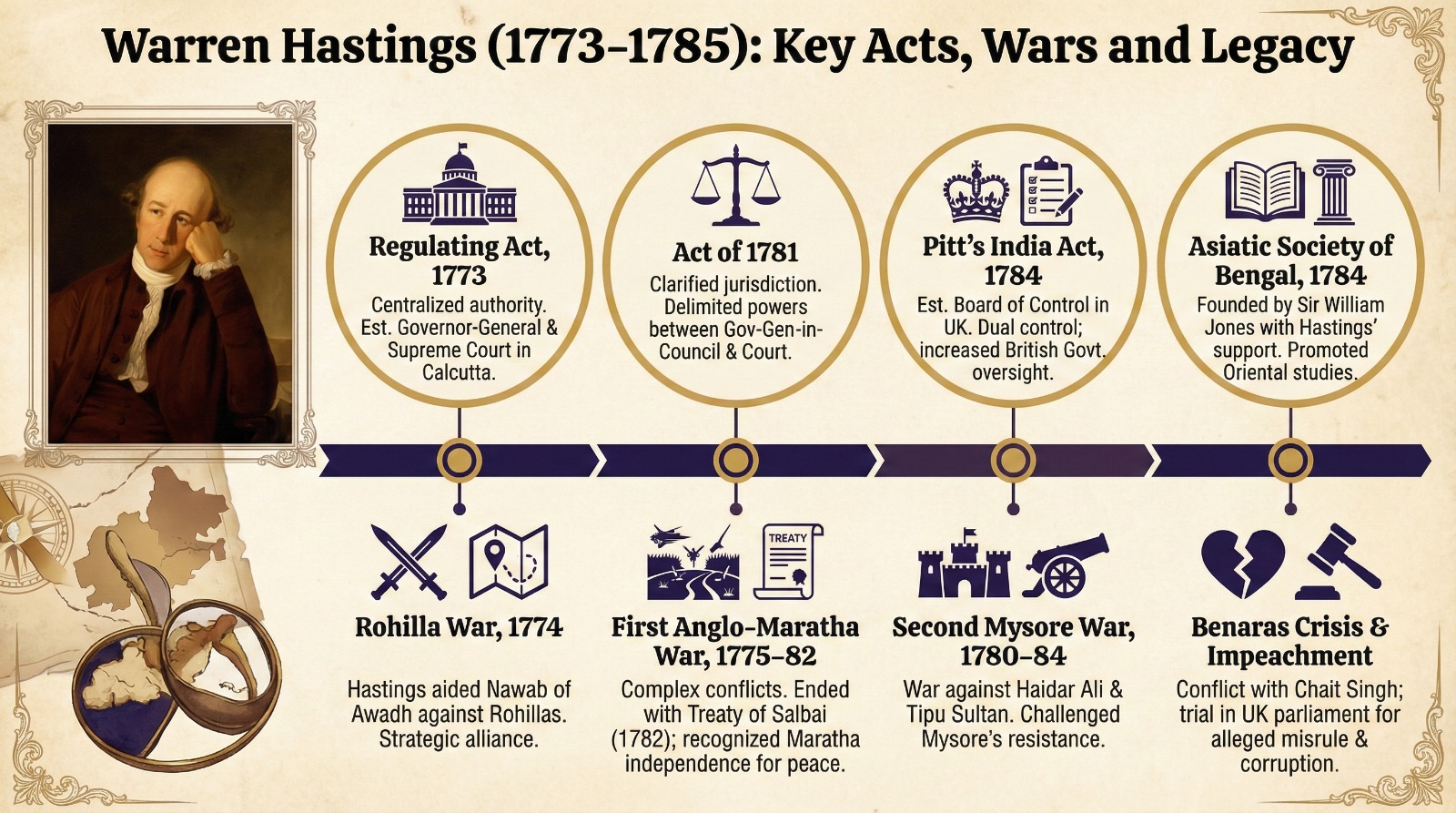
Warren Hastings served as the first Governor-General of Bengal during a decisive phase in early British rule in India. His tenure from 1773 to 1785 is remembered for two parallel developments: British Parliament tightened control over the East India Company, and the Company expanded its political and military footprint through wars, alliances, and revenue pressure. Hastings helped shape the foundations of colonial governance, but also faced strong criticism that ended in his impeachment trial in England.
Key events in his tenure
- Regulating Act of 1773: Start of Parliamentary Control
The Regulating Act of 1773 was the first major intervention by the British Parliament to regulate the East India Company’s growing power. It was driven by concerns about corruption, mismanagement, and unchecked authority.
Key outcomes:
- Created the post of Governor-General of Bengal, with Hastings as the first.
- Set up an executive council to check the Governor-General.
- Established the Supreme Court at Calcutta (1774).
- Resulted in jurisdiction conflicts because boundaries between Court and Company administration were unclear.
- Act of 1781: Fixing the Jurisdiction Crisis
The Supreme Court vs Company administration conflict caused serious disruption, especially in revenue and governance matters.
Key outcomes:
- The Act of 1781 clearly divided powers between the Governor-General-in-Council and the Supreme Court.
- Reduced the Court’s interference in revenue administration.
- Made colonial governance more stable and workable, while also strengthening Company authority.
- Pitt’s India Act of 1784: Stronger British Government Oversight
The Pitt’s India Act (1784) further increased Britain’s control by introducing dual control.
Key outcomes:
- The Company handled commerce and routine administration.
- The British government supervised political and military affairs.
- A Board of Control was created to oversee the Company.
- Marked a major step toward direct state influence over India’s administration.
- Rohilla War (1774): Politics, Payment and Power
The Rohilla War (1774) was linked to Company involvement in North Indian power politics.
Key points:
- The company supported the Nawab of Awadh against the Rohillas of Rohilkhand.
- Company troops were used with financial payment for military help.
- Strengthened British influence but drew criticism for opportunism and revenue-driven warfare.
- First Anglo-Maratha War (1775–1782): A Tough Contest
This war began due to Maratha succession politics and British intervention.
Key points:
- showed the Marathas were still very powerful.
- The Company could not easily dominate them.
- Ended with the Treaty of Salbai (1782).
- The treaty gave the Company time to consolidate and strengthen.
- Second Mysore War (1780–1784): A Major Southern Challenge
Mysore under Hyder Ali (and later Tipu Sultan) resisted British expansion.
Key points:
- The war was one of the toughest conflicts of Hastings’ tenure.
- Triggered by alliances, territorial competition, and British expansion.
- Exposed British vulnerabilities.
- Ended without a decisive victory, but increased British resolve to weaken Mysore later.
- Chait Singh of Benaras: Conflict and Accountability
Hastings’ clash with Chait Singh, Maharaja of Benaras, became a major controversy.
Key points:
- Hastings demanded higher payments and more support due to rising costs.
- Chait Singh resisted, leading to unrest and harsh action.
- Became a key charge in Hastings’ impeachment, symbolising debates on colonial misuse of power.
- Asiatic Society of Bengal (1784): A Cultural and Intellectual Legacy
A major non-military contribution of the period was the Asiatic Society of Bengal (1784), founded by Sir William Jones.
Key points:
- Supported a systematic study of Indian languages, history, law, literature, and culture.
- Helped shape Indology and preservation of texts.
- Also aided colonial governance by improving British understanding of local customs and legal traditions.
Why Warren Hastings Still Matters
Hastings’ tenure represents a turning point where Company rule became more structured and expansionist.
Key takeaways:
- Regulating Act (1773) began formal Parliamentary regulation.
- Act of 1781 resolved major jurisdiction conflicts.
- Pitt’s India Act (1784) increased British state oversight.
- Wars in Rohilkhand, Maratha territories, and Mysore showed the Company’s shift into a political-military power.
- The Benaras episode and impeachment highlighted demands for accountability.
- The Asiatic Society (1784) created a lasting intellectual legacy.
Lord Cornwallis (1786–1793): Reforms, Mysore War, Legacy
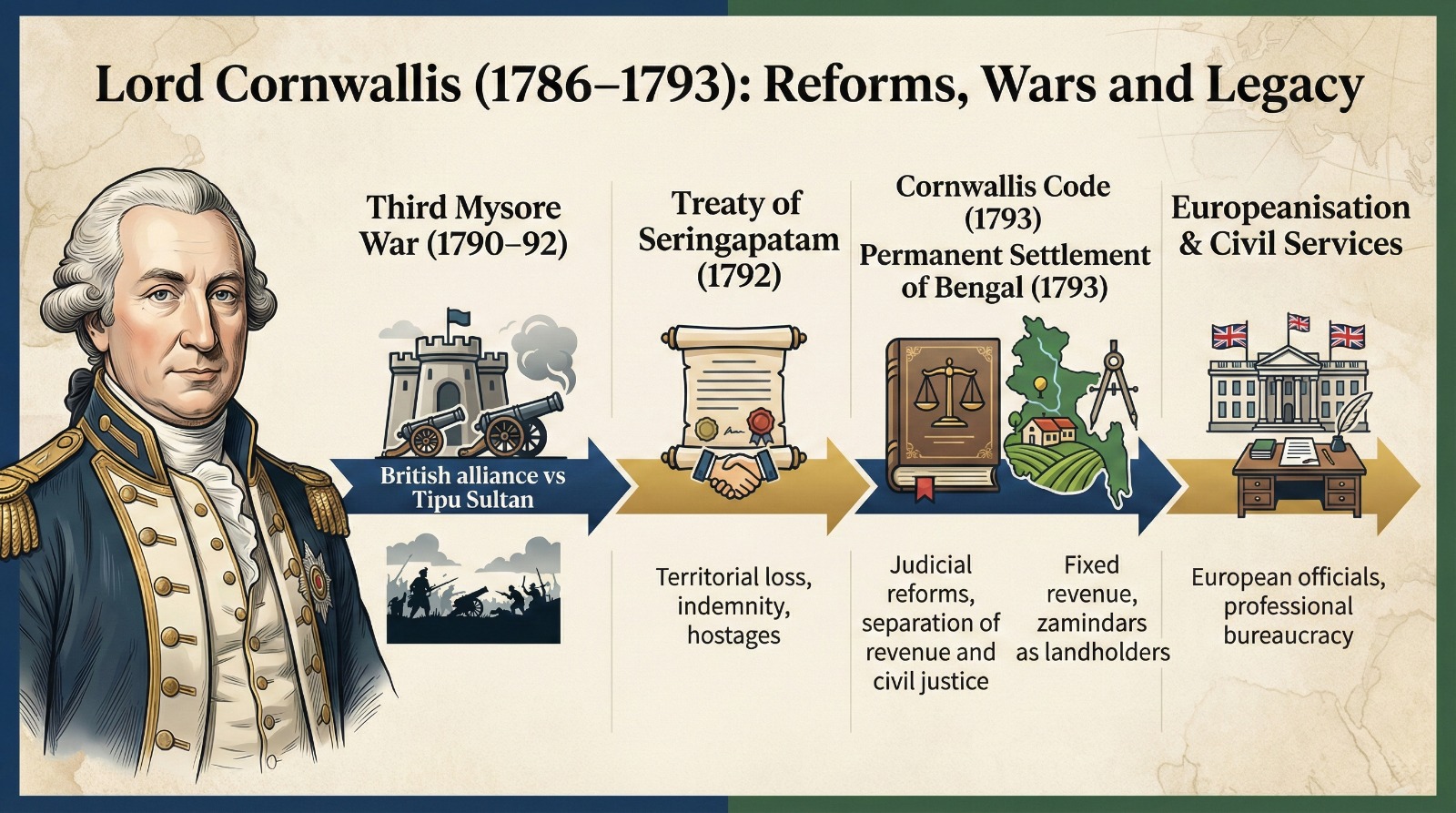
Learn about Lord Cornwallis (1786–93), the Third Mysore War, Treaty of Seringapatam, Cornwallis Code (1793), Permanent Settlement, and civil service reforms.
Lord Cornwallis (1786–1793): Reforms, Mysore War and Legacy
Lord Cornwallis served as Governor-General when the East India Company was turning into a more organised territorial power. His tenure is best understood through two tracks: military consolidation in South India and major administrative reforms that shaped colonial governance for decades.
- Third Mysore War (1790–1792): The Challenge of Tipu Sultan
Cornwallis faced Mysore under Tipu Sultan, which remained the strongest hurdle to British expansion in the south.
Key points:
- Mysore under Tipu Sultan was a major regional power with strong military capacity.
- British fears rose due to Mysore’s strategic ambition and diplomacy.
- Cornwallis used alliance-building plus military pressure to isolate Mysore.
- Coalition mainly included the Nizam of Hyderabad and the Marathas.
- Treaty of Seringapatam (1792): Terms and Significance
The war ended with a treaty that weakened Mysore and strengthened British influence in South India.
Key points:
- Tipu Sultan had to cede large territories to the Company and its allies.
- Mysore was forced to pay a heavy war indemnity.
- Tipu handed over two sons as hostages until payments were secured.
- The treaty reduced Mysore’s power and boosted Company strategic dominance in the south.
- Cornwallis Code (1793): Building a Rule-Based Administration
The Cornwallis Code was a landmark reform package that aimed to make governance more structured and law-driven.
Key points:
- Introduced a more systematic administrative framework.
- Strengthened the judicial structure and formalised procedures.
- Reduced arbitrary decision-making by pushing for clearer rules and processes.
- Supported the idea of a more disciplined and professional administration.
- Separation of Revenue and Civil Justice
Cornwallis separated revenue collection from civil justice to reduce misuse of power.
Key points:
- Revenue officials were earlier involved in both collection and civil decisions.
- This created conflicts of interest and encouraged abuse.
- Reforms aimed to ensure collectors did not act as civil judges.
- Helped build a more departmental and bureaucratic administration.
- Permanent Settlement of Bengal (1793): The Revenue Revolution
The Permanent Settlement permanently fixed land revenue and reshaped Bengal’s agrarian structure.
Key points:
- Recognised zamindars as hereditary landholders responsible for paying revenue.
- Land revenue was fixed permanently, giving the Company predictable income.
- Failure to pay could lead to auction of zamindari estates.
- Created a loyal landed class but often increased peasant exploitation and rural inequality.
- Europeanisation of Administration and the Growth of Civil Services
Cornwallis promoted European dominance in higher administration and strengthened civil service discipline.
Key points:
- Higher administrative posts increasingly reserved for Europeans.
- Reduced Indian participation in top governance positions.
- Encouraged higher pay and stricter rules to curb corruption.
- Laid the early foundations of a more professional colonial civil service culture.
Why Cornwallis Still Matters
Cornwallis’ rule shaped the Company’s empire through war and long-term institutional change.
Key points:
- The Mysore War and treaty weakened a key rival and expanded British influence.
- The Cornwallis Code strengthened the legal-administrative structure.
- Permanent Settlement reshaped Bengal’s agrarian economy and society for generations.
- Civil service reforms increased administrative efficiency but deepened European dominance.