
Bharatiya Antariksh Station (BAS): ISRO’s Indigenous Space Station (2028–2035)
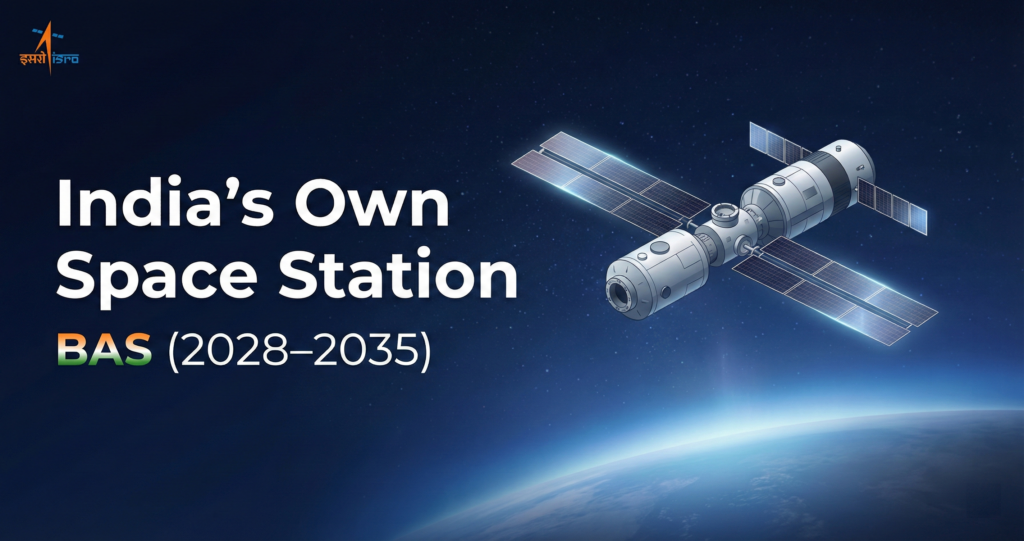
India’s human space journey is entering a new phase—from proving crewed launch capability to building long-term space infrastructure. An official government update on the Indian Indigenous Space Station confirms that ISRO has finalized the overall configuration of India’s space station—Bharatiya Antariksh Station (BAS)—as a five-module platform, with the first module targeted by 2028 and the full station expected to be fully operational by 2035.
This roadmap places India among a small global group of spacefaring powers aiming for a sustained presence in Low Earth Orbit (LEO), and it builds directly on the capabilities being demonstrated under the Gaganyaan programme.
Bharatiya Antariksh Station (BAS)
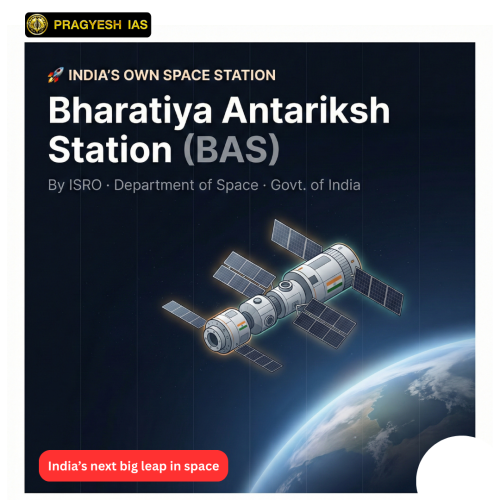
Bharatiya Antariksh Station (BAS) is India’s planned indigenous space station in Low Earth Orbit. ISRO has worked out the station’s overall configuration, comprising five modules. The configuration has also been reviewed by a National Level Review Committee, showing structured oversight and readiness progress.
In simple terms, BAS is intended to be a permanent orbital platform that supports:
long-duration human space missions,
advanced scientific research in microgravity, and
technology development for future human exploration.
Official Timeline: BAS-01 by 2028, Full Station by 2035
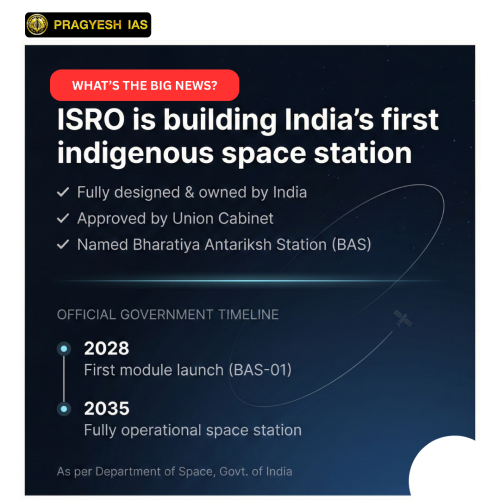
The update confirms two clear milestones:
1) BAS-01 (Base Module) by 2028
In September 2024, the Union Cabinet approved the development and launch of the first module of BAS, called BAS-01 (Base Module), targeted by 2028. Work on overall system engineering and subsystem technology development is progressing.
2) Fully Operational BAS (Five Modules) by 2035
The station is expected to be fully operational by 2035, after deploying and integrating all five modules in orbit.
Funding: BAS Under the Expanded Gaganyaan Programme (₹20,193 crore)
A key point in the official update is how the space station roadmap is being financed and structured.
The budget allocation for precursor missions, and the development and launch of BAS-01, is included within the revised scope of the Gaganyaan Programme. Following Union Cabinet approval in September 2024, the already approved Gaganyaan programme received additional funding, taking the total to ₹20,193 crore.
This matters because it ties India’s strategy into a single long-term framework:
Gaganyaan enables crewed flight capability → BAS enables sustained operations and research in LEO.
Why India Needs Its Own Space Station: Purpose of BAS
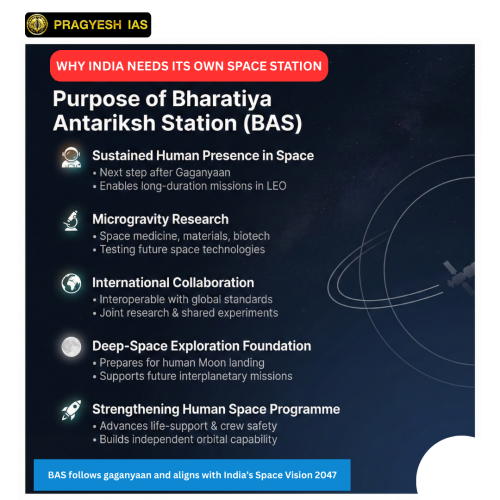
A space station is not only a prestige project—it’s a capability platform. BAS is positioned as the next logical step in India’s sustained human space programme, and it supports multiple strategic and scientific goals.
1) Sustained Human Presence in Space
After Gaganyaan demonstrates safe human transport to LEO and return, BAS extends capability from single crewed missions to long-duration human operations in orbit.
2) Microgravity Research & Technology Development
LEO provides unique microgravity conditions that cannot be replicated on Earth for long durations. BAS enables:
space medicine & human physiology studies,
material science experiments,
biotechnology research, and
fluid physics investigations,
alongside testing and validating future space technologies in real orbital environments.
3) International Collaboration & Interoperability
ISRO is incorporating international standards into BAS-01 subsystem design to ensure interoperability with systems provided by other international agencies. Along with existing cooperation instruments, potential collaboration areas include joint technology development and access to niche test facilities.
4) Foundation for Future Human Exploration
BAS is also framed as an enabling step for future Indian human exploration missions—supporting the longer-term goal of an Indian human landing on the Moon, as envisioned under India’s Space Vision 2047.
5) Strengthening India’s Human Space Programme
Operating a space station demands reliability in life-support, crew safety systems, orbital operations, docking interfaces, power systems, thermal control, and mission planning. BAS is designed to help India build these capabilities at scale—strengthening independent human spaceflight readiness.
What BAS Means for India’s Space Future
With BAS, India is moving toward a more mature space posture:
from “missions” to infrastructure,
from “demonstrations” to sustained operations, and
from “capability building” to continuous scientific output in LEO.
If executed on schedule, the 2028–2035 roadmap will mark a major strategic shift—where India doesn’t just reach orbit, but operates in orbit with long-term intent.
Quick Summary (Key Points)
Bharatiya Antariksh Station (BAS): India’s indigenous space station in LEO
Planned structure: Five modules
First module (BAS-01): targeted by 2028
Fully operational station: expected by 2035
Funding/program link: BAS-01 and precursor missions included under expanded Gaganyaan scope (₹20,193 crore)
Design direction: international interoperability standards + collaboration exploration
Strategic role: next step after Gaganyaan, aligned with India’s Space Vision 2047