16th Finance Commission Recommendation (2026–31) Centre–State fiscal sharing, grants, local...
Read More
16th Finance Commission Recommendation (2026–31)
Centre–State fiscal sharing, grants, local bodies, and fiscal discipline
States’ share in divisible pool
Total grants (2026–31) {Lac cr}
Contribution to GDP
Report submitted
Report tabled
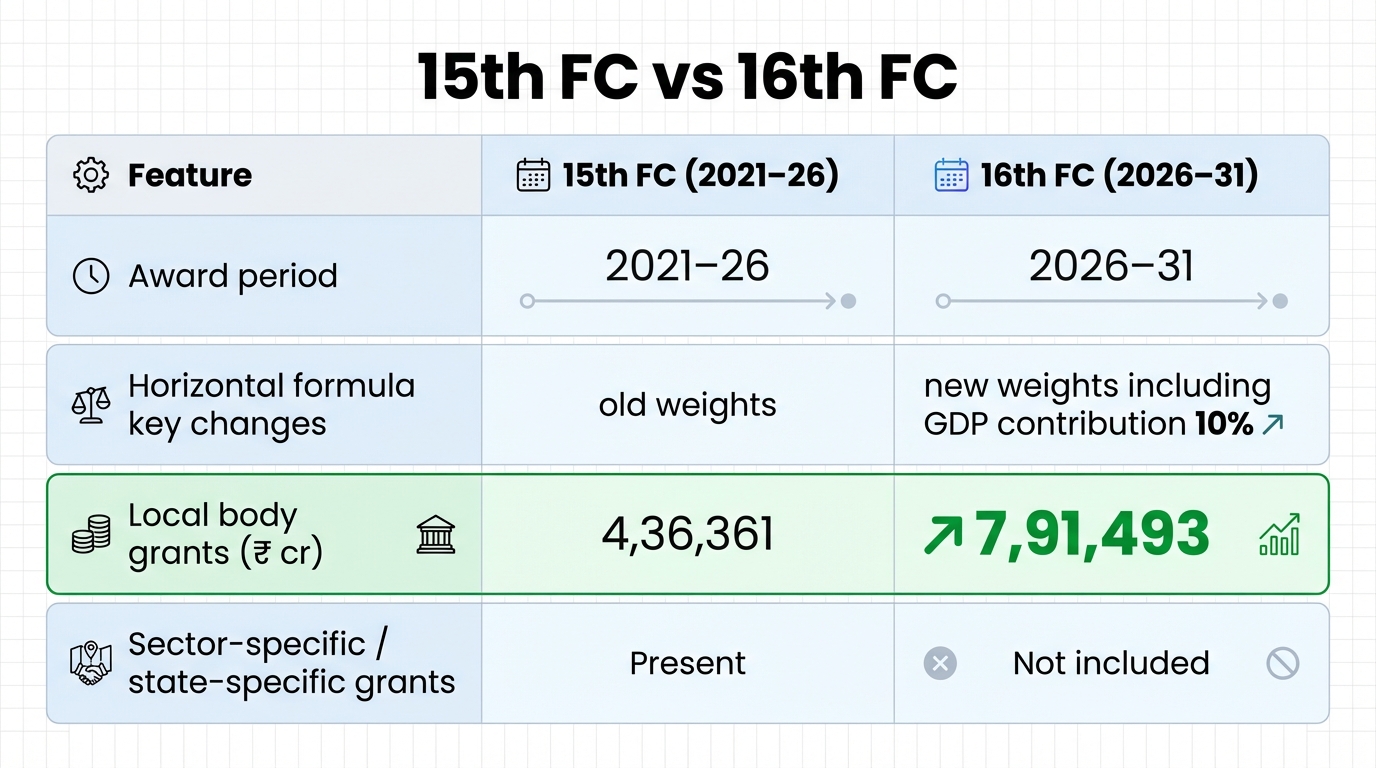
Award period
“This page explains what the Finance Commission is, what the 16th FC recommended, and what changed vs the 15th FC.”
What is the Finance Commission?
- Constitutional body constituted by the President (typically every five years) to recommend Centre–State fiscal transfers.
- Recommends tax devolution + grants-in-aid + support to local bodies + other referred matters.
- Goal: reduce vertical & horizontal imbalances; strengthen cooperative federalism
Constitutional Basis
Article 280 — Finance Commission
- The President constitutes the Finance Commission.
- It recommends distribution of the net proceeds of taxes between Union and States and among States.
- It also recommends principles for grants-in-aid and measures to strengthen Panchayats and Municipalities.
Related provisions
Article 275 (grants-in-aid), Article 281 (report laid before Parliament), Article 279 (CAG-certified net proceeds transparency context), Article 293(3) (borrowing oversight context)
16th FC: Leadership & Timeline
16th FC at a Glance
- Constituted: 31 Dec 2023
- Report submitted to President: 17 Nov 2025
- Tabled in Parliament: 1 Feb 2026
- Award period: 2026–27 to 2030–31
16th FC at a Glance
- Chairman: Dr. Arvind Panagariya
- Members: Smt. Annie George Mathew (Full-time), Dr. Manoj Panda (Full-time), Dr. Soumya Kanti Ghosh (Part-time), Shri T. Rabi Sankar (Part-time)
- Secretary: Shri Ritvik Ranjanam Pandey
Tax Devolution (2026–31)
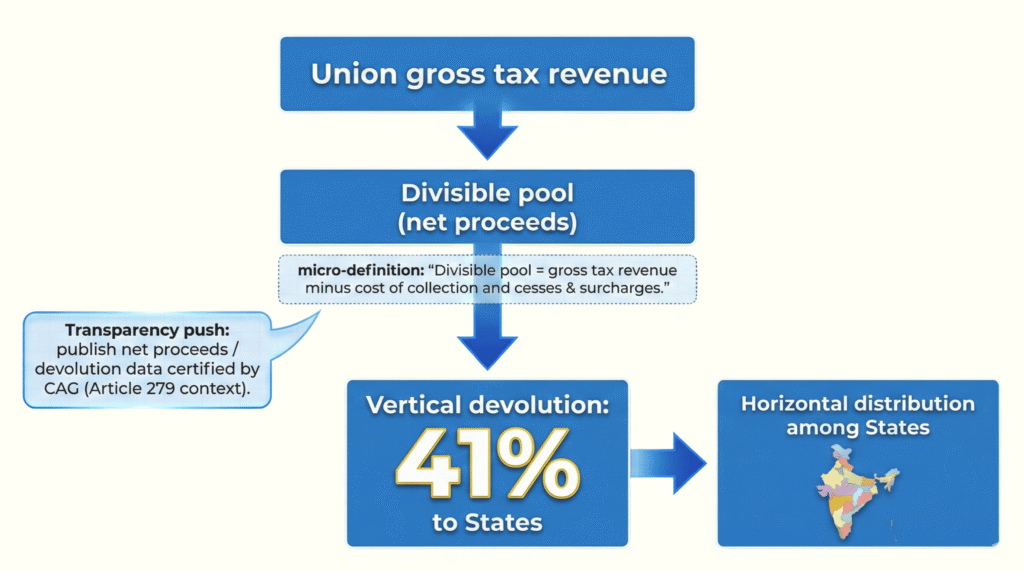
Tax devolution has two layers: how much goes to States (vertical), and how it’s shared among States (horizontal).
The Money Flow
Transparency push: publish net proceeds / devolution data certified by CAG (Article 279 context).
Vertical Devolution
This is the aggregate share for all States together.
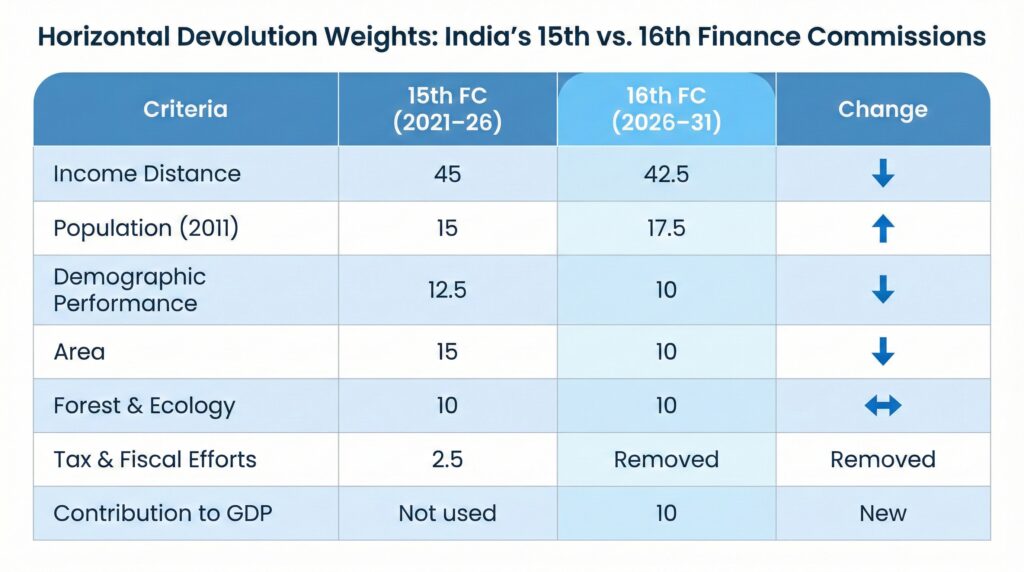
Horizontal Devolution
- Income distance: Equity support for lower-income states.
- Population (2011): Current needs and scale.
- Demographic performance: Rewards better population outcomes.
- Area: Cost disabilities of size.
- Forest: Ecological services and conservation effort.
- Contribution to GDP: Recognises output contribution/performance.
16th FC vs 15th FC — Horizontal weights (%)
NEW: GDP contribution added
REMOVED: Tax & Fiscal Efforts
Shift: Population ↑, Area ↓
Grants-in-Aid (2026–31)
Total grants (2026–31) {Lac cr}
What’s discontinued (clear “Not recommended” panel)?
“Not recommended by 16th FC:”
- Revenue deficit grants
- Sector-specific grants
- State-specific grants
“Focus shifts toward formula-based transfers and structured grant design.”
Local Government Grants: Structure & Rules
Rural Local Bodies (RLBs): ₹4,35,236 cr
- Basic: ₹3,48,188 cr
- Performance: ₹87,048 cr
Urban Local Bodies (ULBs): ₹3,56,257 cr
- Basic: ₹2,32,125 cr
- Performance: ₹58,032 cr
- Special Infrastructure Component: ₹56,100 cr (wastewater management)
- Urbanisation Premium: ₹10,000 cr (one-time)
How it’s structured?
- RLB : ULB (Basic+Performance combined) = 60 : 40
- Basic : Performance (both RLB & ULB) = 80 : 20
- 50% of Basic is tied (Sanitation/SWM and/or Water management)
Guardrails
- Untied grants not for salaries/establishment
- No local body spends > 20% of untied grants on roads
- Release in minimum two instalments yearly
- States transfer FC grants to local bodies within 10 working days (else interest)
Urbanisation Premium detail
- “₹2,000 per person (Census 2011 basis), linked to peri-urban village mergers into ULBs + rural-to-urban transition policy.”
Disaster management financing
State-level funds
State-level (SDRF + SDMF): ₹2,04,401 cr (2026–31)
- Union share: ₹1,55,915.85 cr | States: ₹48,485.15 cr
- Cost sharing: 75:25 (non-NEH) | 90:10 (NEH)
- Split: SDRF 80% (₹1,63,521 cr) | SDMF 20% (₹40,880 cr)
Condition: from 2027–28, states must complete NDMIS data feeding/validation by May 31 (succeeding year)
National-level funds
National-level (NDRF + NDMF): ₹79,406 cr (2026–31)
- Add graded contribution note: “10% up to ₹250 cr; 20% up to ₹500 cr; 25% above ₹500 cr (NEH: 10%).”
Fiscal Discipline & Reforms
States fiscal deficit cap: 3% of GSDP (with “Article 293(3) oversight” tag)
Union fiscal deficit target: 3.5% of GDP (by end of award period)
Off-budget borrowing
Before:
“Off-budget borrowings (hidden liabilities)”
After:
“Bring borrowings on-budget (transparent, accountable)”
FRL/FRBM alignment
- “Align State Fiscal Responsibility laws with the consolidation roadmap.”
- “Standardise reporting and close loopholes.”
Reform tiles (2×2)
- Centrally Sponsored Schemes: rationalise for efficiency
- Power sector reforms: improve governance, reduce leakages
- Subsidies: better targeting and containment
- PSUs/PSEs: performance and accountability reforms
What changed from the 15th to the 16th FC?
Stay Updated!
Charles Metcalfe (Acting Governor-General, 1835–1836) Profile Charles Metcalfe served as...
Read MoreWilliam Bentinck(William Henry Cavendish-Bentinck) Profile Governor-General of Bengal: 1828–1833 Governor-General...
Read More